

Congressional candidates visit Chiefland
One candidate reminds people July 20
is final day to switch parties
for Aug. 18 Primary Election
Story and Photos By Jeff M. Hardison © July 20, 2026 at 3 p.m.
All Copyrights Protected By Federal Civil Law
Do Not Copy and Paste to Social Media or Elsewhere
CHIEFLAND – Three of the six people seeking to be the next member of the Florida District 3 Seat in the United States House of Representatives visited Chiefland on July 16 as part of a gathering in the Tommy Usher Community Center where candidates spoke to some voters.
Of those six, Kat Cammack (R-Gainesville), who is the incumbent who won the primary for Republican (unopposed), was not present.
The men who showed up are Troy Albers (D-Lake City), Seth Harp (D-Gainesville) and Mike Klein (NPA-Gainesville).
Like Cammack, Klein won his primary race and is the candidate from the NPA set of voters. And yet, he showed up.
Albers, Harp and Klein told audience members a bit about themselves at this event. All of the Levy County voters who are registered as Democrats will choose between Albers, Harp and George Hubac (D-Gainesville) and Tom Wells (D-Gainesville).
Therefore, on Nov. 3 in that race, it will be Cammack versus Klein, as well as either Albers, Harp, Hubac or Wells being in the mix from which voters must choose.
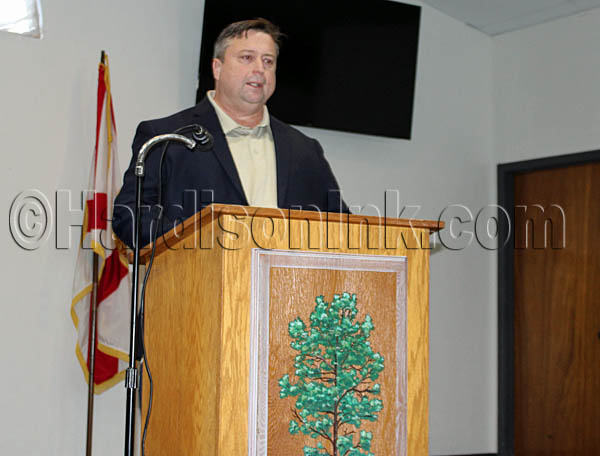
Troy Albers speaks at the lectern.
Troy Albers
Albers lives in Columbia County, and he said he enjoys being in Levy County again. He served in the United States Navy for six years, and 14 years in the United States Army, and 10 years in the Florida National Guard.
Beyond the 30 years of military service, he has been a farmer raising cattle and goats in Columbia County. He and his wife Rachael have three children, and a 9-month-old grandson.
The Third Congressional District of Florida, he said, is the largest geographic district in the state. This district includes 12 counties -- the entirety of Alachua, Baker, Bradford, Columbia, Dixie, Gilchrist, Hamilton, Lafayette, Levy, Suwannee, and Union counties, as well as the majority of Marion County.
Unemployment, healthcare and inflation are three factors impacting this part of the nation, he said.
As far as healthcare in these 12 counties, people can go to Gainesville or Ocala for hospitalization, he said.
Unemployment in Florida is 4.8 percent and in Levy County it is 5.5 percent now, he said.
The Federal Reserve reports that the most recent official unemployment rates (as of May 2026) are 4.8 percent for the state of Florida (seasonally adjusted) and 5.3 percent for Levy County (not seasonally adjusted).
In Chiefland, Albers said, the unemployment rate is 7.5 percent. That is from a labor force of 1,600 people in a city with a population of 2,300 people, he added in regard to Chiefland. And there are 120 people in Chiefland who have no source of income, he added.
With that many people who have no source of income in Chiefland, Albers said, “We’ve got to change the way we do things.”
His single method to help alleviate this problem is to “treat every person you come in contact with as a customer.” Some people have gotten into the culture of “name-calling or whatever else you want to call it,” Albers continued, “but it’s not worth it.”
He said Florida needs more tourists to frequently visit the state’s restaurants, hotels, motels and attractions.
Albers went on to say the Number One job in Florida is truck driving.
He said Levy County Supervisor of Elections is among the best civil servants he knows. He urged independent voters and NPA voters to change to be Democrats by the ed of normal business hours on July 20 so that they can choose him from among the Democratic Party candidates in the Aug. 18 primary.
Publisher’s Note: A telephone call to Levy County Supervisor of Elections Tammy Jones showed that if a person goes into that office in Bronson today (July 20) before 4:30 p.m., they can register to vote in the primary or they can change parties to vote in either the Republican Party or the Democratic Primary. If a person uses the online method to change parties in Levy County, they can do so until midnight tonight (July 20). Remember, though, there are two Levy County Republicans seeking election to run in the General Election against a Democrat and an Ecology Party candidate. Switching from Republican to Democrat in Levy County will help decide the Democrat running in the District 3 United States House of Representatives race, but then the choice of which Republican to run in the November local race will be off the ballot for that Levy County voter.
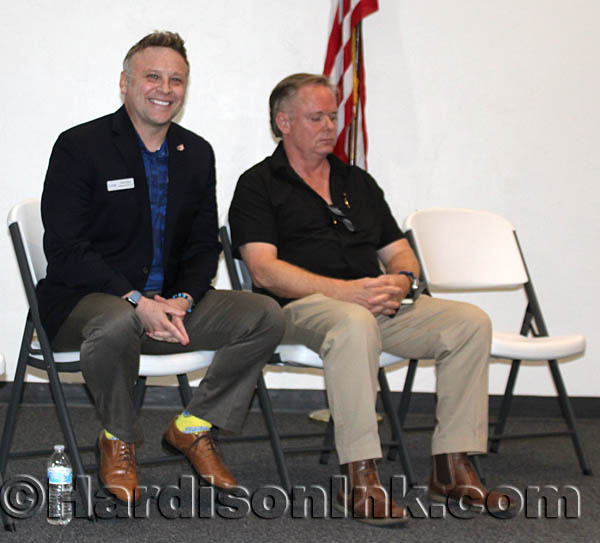
Seth Harp (left) and Mike Klein are seen as they listen to Troy Albers
Seth Harp
Harp said he teaches civics to seventh grade students at Lincoln Middle School in Gainesville. Before becoming a teacher, Harp said he was in broadcasting for several years.
This fall marks an anniversary of his first “newscast” on a Kalamazoo, Michigan, radio station, he said.
Harp said a recent poll shows 66 percent of Americans see grocery costs as the most important issue facing them now. He intimated that the cost of fuel, resulting from the war in Iran is part of the reason for food costs leaping to new highs, because transporting groceries takes fuel.
Since Feb. 28, 2026, the United States and Israel have been at war with Iran and its regional allies. Hostilities broke out after airstrikes by the United States and Israel killed several Iranian officials, including Supreme Leader Ali Khamenei.
Harp said he feels the cost of orange juice and cold cuts are too high, and this is what consumers must bear as a result of the war.
As for how he is voting on the change in the Florida Constitution regarding property tax revisions, Harp is voting “No.”
A goal without a plan is nothing more than a wish, Harp said. He said state government leaders have no plans to make up for counties losing a main source of revenue.
Harp said to see his issues, click HERE.
Mike Klein
As noted, Klein won the Aug. 18 primary vote, and he is moving toward the Nov. 3 race, where he hopes to beat Republican Cammack and one of the Democrats -- Albers, Harp, Hubac or Wells.
Klein mentioned to Harp that even though Harp is a teacher at Lincoln Middle School, he was a student there before Harp was born.
Lincoln Middle School began as an all-black high school before a federal desegregation order closed it and later reopened it as a middle school. From 1923 to 1970, it operated as Lincoln High School (originally located at Northwest Seventh Avenue and then moved to Southeast 12th Street in 1956), according to records.
During segregation, it was one of the most prominent all-Black schools in Florida. The high school was forced to close abruptly in 1970 during the integration of Alachua County schools. Shortly after the high school shut down, the campus was reopened as a desegregated middle school, which it remains to this day.
Klein said he is a fifth-generation Floridian, who grew up in Gainesville in the 1970s. When he was 17 years old, Klein said he was inducted into the United States Military Academy at West Point (Orange County, New York). He became an infantry officer in the United States Army, went to Ranger School and was in the Airborne part of the Army, where he fought in Desert Storm. On Jan. 16, 1991, the offensive action against Iraq was codenamed Operation Desert Storm, and it was carried out under provisions of 12 United Nations Security Council resolutions, according to records.
In 2003, Klein left the military. He eventually returned to Gainesville after a career in business and economic development, with stints in South America and Europe.
“My day job now is chairman and co-founder Warrior Centric Health,” Klein said.
That is a nonprofit organization dedicated to improving the quality of healthcare for military personnel and veterans around the United States.
Klein is running for Congress, he said, because his oath the protect and defend the United States Constitution does not have an expiration date.
“Our Constitution, our families, our futures,” and all else that is in the United States is being destroyed now by corruption, Klein said.
Washington, D.C., is a rigged game, Klein said, adding that both the Republican Party and Democratic Party are complicit in this corruption. Both parties have the same donors and special interests that are creating policies, he said. Prices are high as a result of this corruption, he added.
The war in Iran, Klein said, is an immoral, illegal and stupid action.
Klein said he is running as an “independent” because neither of the two dominant parties can be trusted.
He is refusing donations from corporate Political Action Committees or special interests.
If the voters put him in Congress, Klein said, “I don’t have to be worried about being threatened by party bosses or special interests moving forward.”
He said there are currently five independents in Congress. If there were six, he added, then those six could create a coalition so that nothing could happen without the independents signing off on it – unless one of the two parties on a vote had members who would go with the “other side.”
He said there is a movement in the country now by military veterans who are seeking elections as independents. This is a viable option that can lead to victory to reduce corruption in federal government, Klein said.
“If you want to drain the swamp,” Klein said, “you are going to have to vote in an actual, real Gator.”
16 candidates speak at two-hour forum
Some comments and responses are heated
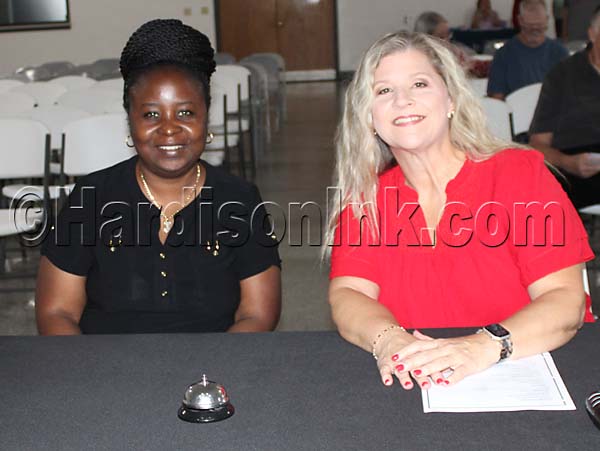
Chiefland City Commissioner LaWanda Jones (left) and Chiefland City Manager Laura Cain serve as the timekeeper and moderator respectively Thursday night (July 16) in the Tommy Usher Community Center.
Story and Photos By Jeff M. Hardison © July 17, 2026 at 11:15 a.m.
All Copyrights Protected By Federal Civil Law
Do Not Copy and Paste to Social Media or Elsewhere
CHIEFLAND – Sixteen candidates in races to be a member of the United States House of Representatives, to be governor, to be a member of the Florida House of Representatives, to be a member of the Levy County Board of County Commissioners or to be the Levy County Court judge spoke to people at the Tommy Usher Community Center in Chiefland on Thursday night in what is bound to be the biggest and best candidate forum of the year for the Tri-County Area.
This forum was sponsored by the City Commission of Chiefland.
There were some relatively barbed comments in the answers given to questions. Chiefland City Managers Laura Cain welcomed everyone and then Chiefland Fire Chief Dwayne King gave an opening prayer followed by City Manager Cain leading the people in saying the Pledge of Allegiance to the American Flag.
Publisher’s Note: Given the amount of information in each race, HardisonInk.com plans to provide seven different stories in the coming days. Meanwhile, on Aug. 20 and 21 the deadlines for candidates who were polled previously with some questions, are set to continue being published like the first of such stories -- which is on the LIFE PAGE.
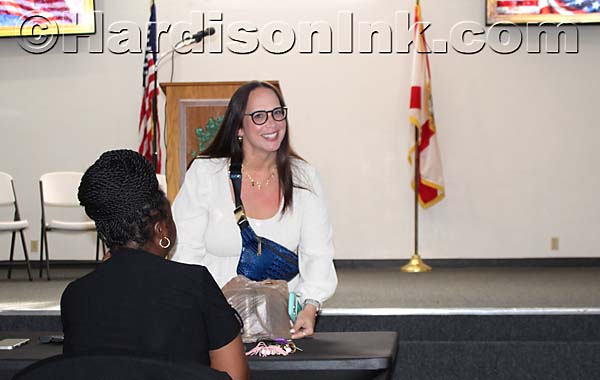
Chiefland Mayor Lewrissa Johns notices a camera aimed at her as she speaks with Chiefland City Commissioner LaWanda Jones just before the 6 p.m. start of the two-hour event.
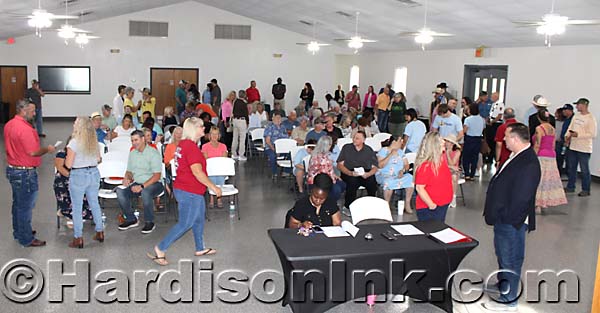
The crowd of individuals who came to the event socialize moments before Chiefland City Manager Laura Cain asks those audience members to please take seats.
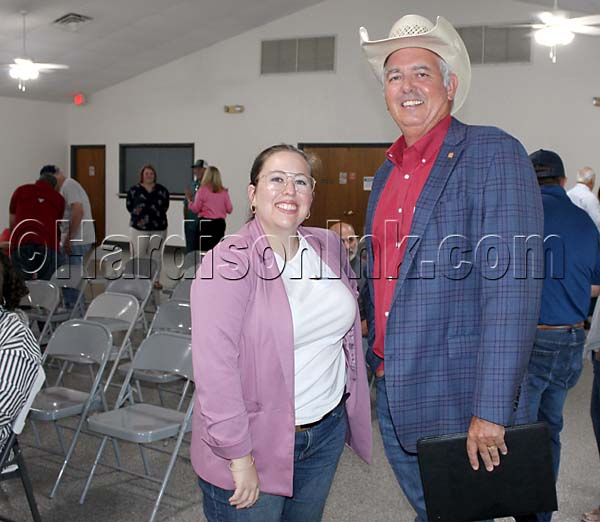
Amy Trask (D-Gainesville), the unopposed winner of the Democratic Party nomination to run for Florida House of Representatives District 22 (left) and incumbent State Rep. Chad Johnson (R-Chiefland, Dist. 22) the unopposed winner of the Republican Party nomination to run for Florida House of Representatives District 22, both agree to a journalist's request for a photo opportunity. They had some moments during this event where they had some civil discourse showing differing opinions and methods of leadership in the seat they both seek. Voters are set to make that choice in November.
Gubernatorial Race
The 2026 Florida gubernatorial election will be held on Nov. 3. Primary elections to pick the Republican and Democratic candidates for governor are on Aug. 18. Incumbent Gov. Ron DeSantis is ineligible to seek reelection due to term limits.
Bobby Williams (R-Eagle Lake), one of the 11 Republicans hoping to win the Republican nomination on Aug. 18, spoke to the people in Chiefland. He was the first of the 16 candidates to speak there that night. City Manager Cain gave him that leeway due to his self-reported need to be at another event on his campaign trail that night.
County Commission – Dist. 2
Lincoln Cannon (DEM), Emily Casey (ECO), Wesley Langston (REP) and Matt Lemery (REP) were the first local candidates to speak that night. Registered Republican Party voters in Levy County will choose either Langston or Lemery when those voters actually vote on Aug. 18. After one of those two Republican Party candidates wins the primary, he will run in a three-way race for this position with Cannon, and Casey, who won their primary races for their political parties – Democrat and Ecology respectively.
County Commission – Dist. 4.
Either Billy Hinote (REP), Tim Hodge (REP) or David Sharpe (REP) will become the county commissioner to be elected, or in Hodge’s case to be reelected, to the County Commission District 4 seat in the Aug. 18 primary election. In this three-man race, all voters in Levy County who actually vote on Aug. 18 will decide the winner. In this race of that primary, Republicans, Democrats and all other parties’ members and non-party affiliate voters will see those names in that one race on the ballot.
County Court Judge
Only County Court Judge Luis Bustamante was at the forum on Thursday night in Chiefland. Darla Whistler is the other candidate in that non-partisan race. This race will be decided Aug. 18 by all voters, too.
School Board – Dist. 3
Jaime Handlin and Tricia Horvath want to be members of the Levy County School Board. Levy County voters will choose the winner in that non-partisan race in the Aug. 18 election.
Florida House – Dist. 22
Incumbent State Rep. Chad Johnson (R-Chiefland) and Amy Trask (D-Gainesville) both won their parties’ primaries. Their race will be decided Nov. 3.
Both candidates presented their stances well, at times poking verbal jabs at each other in a civil manner, as one expects from civilized humans.
U.S. House – Dist. 3
Troy Albers (D-Lake City), Seth Harp (D-Gainesville) and Mike Klein (NPA-Gainesville) are among the candidates that include Kat Cammack (R-Gainesville), who is the incumbent who won the primary for Republican (unopposed). Albers, Harp and Klein showed up and told audience members a bit about themselves at this event. Also, in this Aug. 18 primary race to be chosen as the Democrat to run against Cammack is George Hubac (D-Gainesville) and Tom Wells (D-Gainesville).
Therefore, on Nov. 3 in that race, it will be Cammack versus Klein, as well as either Albers, Harp, Hubac or Wells being in the mix from which voters must choose, or not choose if they skip voting – even though in a democracy there is the concept of people caring enough about who leads the government that they would seek information about candidates and then choose as they believe is best when they cast a ballot.
Tim West appointed
as city commissioner from 3-0 vote
By Jeff M. Hardison © July 15, 2026 at 7 a.m.
All Copyrights Protected By Federal Civil Law
Do Not Copy and Paste to Social Media or Elsewhere
CHIEFLAND – Tim West did it again. He is going to be a member of the Chiefland City Commission.
His first term in office was in 2018 when he won a tie vote by selecting the long straw. The late Levy County Court Judge J.T. “Tim” Browning performed that decision-making action. In that vote, where every ballot counted and a long straw was required to break the tie, incumbent City Commissioner Teresa Barron, agreed to a peaceful transfer of power.
Meanwhile, during the regular Chiefland City Commission meeting on Monday night (June 13), West won again.
To see and hear the Aug. 7, 2018 story, photos and video from the story headlined -- Tim West wins Chiefland election by choosing the long straw; 90-90 vote is broken by drawing lots - per the law, click HERE.
To see the Sept. 12, 2018 story and photos (including photos with the late Betty Walker and the late Chris Jones) under the headline -- Two City Commissioners Take The Oath Of Office; Outgoing Chiefland City commissioner is awarded a plaque for 14 years of service, click HERE.
When West sought reelection, he was defeated by Lance Hayes.
To read the Aug. 5, 2020 story and see a photo under the headline -- Lance Hayes wins Chiefland election by a landslide 132-70, click HERE.
On July 13, Chiefland City Manager Laura Cain said letters of interest for appointment had been sent by the City Commission to fill the vacant City Commission Seat Group 1 Seat after the death of City Commissioner Chris Jones. Four men responded with their letters of intent to serve if appointed.
City Manager Cain advised the commission that those four letters of intent were submitted by -- Rawl DePeiza and Alfred Latson, who were in attendance at the meeting that Monday night, and two other men.
Both of those men told the City Commission on July 13 why they would like to take the seat. Sherod Richardson had sent correspondence, as had West. Neither Richardson nor West were at the meeting on July 13.
Chiefland Mayor Lewrissa Johns sought discussion from the City Commission about who to choose to fill the vacancy until the next election for the Group 1 Seat, where that person will complete the term of the late City Commissioner Jones.
Vice Mayor Norman Weaver said he had read all of the intent letters and felt like Timothy “Tim” West was the most qualified candidate due to the fact that he has prior commission experience, as well as West currently owning one business in the city and constructing another business.
Chiefland resident Alice Monyei, a former City Commission member, asked if West was required to be in attendance for consideration of appointment to the post. Mayor Johns advised Monyei it was not a requirement for the candidates to be in attendance for consideration of appointment.
Vice Mayor Weaver moved to appoint West as the commissioner for the Group 1 seat until the next election, and his motion was seconded by Commissioner Kim Bennett. The motion carried on a 3-0 vote. Chiefland City Commissioner LaWanda Jones was absent from this regular twice-monthly City Commission meeting.
Other Action
Among the various other actions in the meeting that lasted an hour and 18 minutes:
● A 3-0 vote approved an interlocal agreement between the City of Chiefland and the Levy County School Board for the annual renewal of school crossing guards for the 2026-2027 school year. The total reimbursement from School Board to the City of Chiefland is $30 per day / per location for each day of student attendance.
● A 3-0 vote approved the Preliminary Annual Fire Assessment Resolution will continue the process for imposing a fire assessment for fiscal year 2026-2027 in the city. The resolution provides the following: $159 per residential dwelling unit; five-center per square foot for non-residential buildings; $10 per vacant parcel. These provisions will generate approximately $215,852.
Mayor Johns asked City Manager Cain if she had received any participation numbers from the Chiefland Area Athletic Association. Cain said that although she had requested that information from CAAA leadership, there was no response as of the time of the meeting. The mayor Johns said she wants an agenda item listed to discuss this matter at the next regular meeting.
Williston City Council edges
toward city manager placement
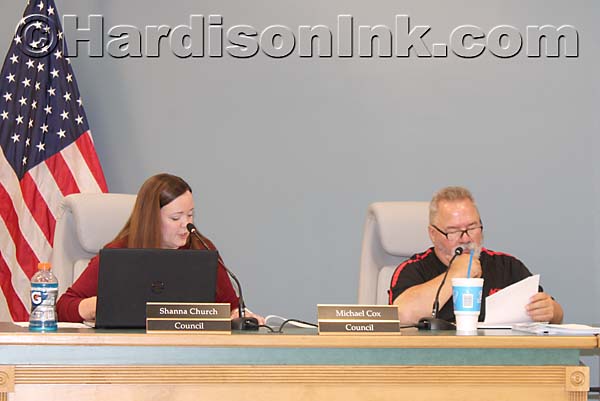
Williston City Councilwoman Shanna Churvh, the newest member of the elected body, shares input about what she thinks about filling the city manager vacancy. Sitting next to her is City Councilman Michael Cox.
Story and Photos By Jeff M. Hardison © July 14, 2026 at 5 p.m.
All Copyrights Protected By Federal Civil Law
Do Not Copy and Paste to Social Media or Elsewhere
WILLISTON – All five members of the Williston City Council worked at the dais from 7:19 p.m. until 11:14 p.m. during a special meeting Monday night (July 13) as they created a new version of a job description for the next city manager to be hired by them.
The meeting included a five-minute recess at 10 p.m.
They decided on a starting annual salary of $95,000.
And, they chose to hire Terry Bovaird, a former Williston city manager, to serve three days a week as the interim city manager, with City Clerk Latricia Wright accepting the duties of interim city manager on Tuesdays and Thursdays as she switches roles weekly until some day in the future when a full-time city manager is hired. For the past four months, Wright has served as the primary interim city manager with some help from Williston Police Chief Mike Rolls.
While Rolls was in his interim city manager role, WPD Maj. Matthew Fortney served as acting police chief.
During the arduous somewhat marathon special meeting – late into Monday night, City Council President Darfeness Hinds, Vice President Debra Jones and City Council members Shanna Church, Michael Cox and Meredith Martin used a 2022 version of the job description, supplementing it with pieces from a 2024 version as well as looking at material provided by Williston Human Resources Director Kim Troy. Also, Vice President Jones brought samples from various other cities regarding their job descriptions of city managers in Florida.
Williston City Attorney Kiersten Ballou helped the City Council as she listened carefully to the discussions, and then concisely recited to the City Council members what she thought they had said and meant regarding several aspects of the whole process, including the creation of the latest job description.
At the next regular Williston City Council meeting, scheduled to be July 21 starting at 6 p.m. and held in Williston City Hall, if all goes as planned now – City Attorney Ballou will provide the City Council members with the new and improved job description for the city manager, as well as the contract to hire Bovaird as the interim city manager for three days a week, and the final version of the new job posting that will be provided to various points where city manager candidates go to see job openings.
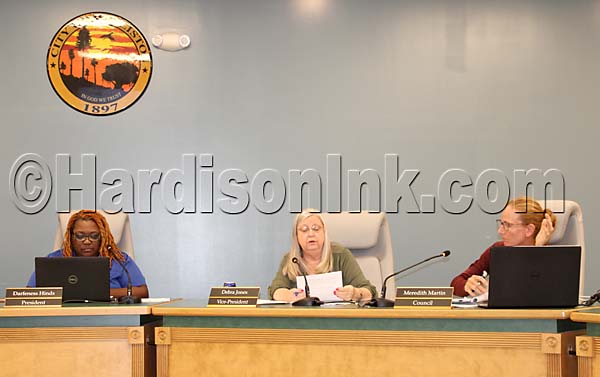
(from left) City Council President Darfeness Hinds, Vice President Debra Jones and City Councilwoman Meredith Martin discuss matters related to the job description for city manager.
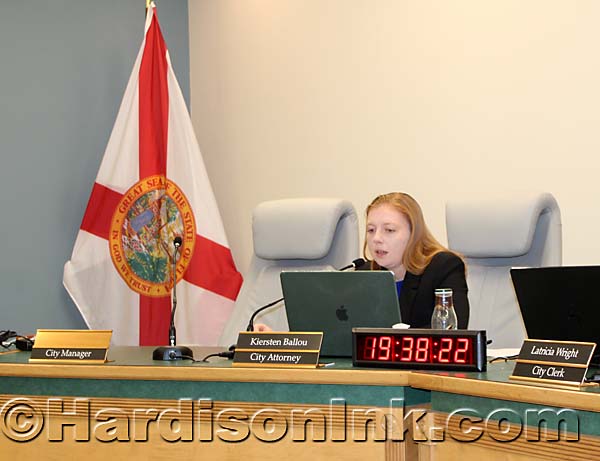
Williston City Attorney Kiersten Ballou helps the City Council as she clearly restates some of the concepts that they had agreed to during part of the discussion on Monday night (July 13).
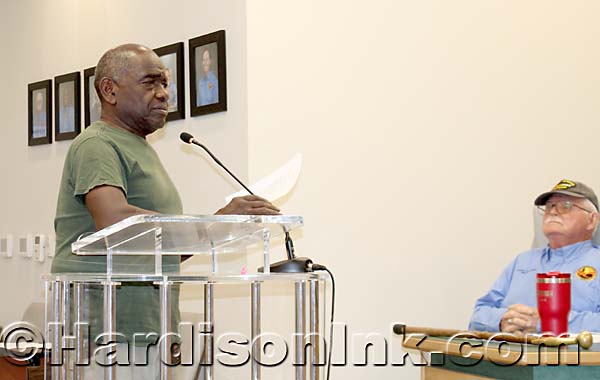
Albert Fuller Sr., a well-known community leader in Levy County as well as Williston, asks when the City Council will hear input from the public during its special meeting on Monday night. His question helped lead to that part of the process being clarified. Sitting at the dais, Mayor Charles Goodman listens to Fuller. It was Mayor Goodman who pressured the City Council into actually working toward hiring a city manager – especially to relive the much-overburdened City Clerk Latricia Wright – who has had to shoulder most of the burden of city manager duties as well as being the city clerk. That excessive demand on one person is also essentially contrary to what Article II, Section 5(a) of the Florida Constitution notes in regard to a city clerk holding both the office of city manager and the office of city clerk at the same time. This is known simply as the state constitution’s dual officeholding prohibition.
Unlike a recent regular meeting, the five city leaders quickly approved the “Additions, Deletions, Changes and Approval of the Agenda” as it was presented for the special meeting.
Like some meetings, the “Public Participation” part of the meeting included opinions stated by some members of the public.
Once the “new business” part of the meeting started moving forward to find a new city manager, one resident helped the City Council understand the need to let listeners know when they could provide their input. Albert Fuller Sr., a well-established civic leader in Williston, helped other members in the audience understand methods for input as well as which documents the City Council members were using as they plodded along through their creation of a job description for the city manager of Williston.
During part of the process, there was a point where minutia such as the ability to use certain equipment that was listed included a fax machine being in the set of specific machines noted. At that point, it was only President Hinds who said she still uses a fax. At another point, City Council members were reminded that Windows is an operating system and programs like Microsoft’s Office 365 work within that system.
Microsoft Office, MS Office, or simply Office, is an office suite and (formerly) a family of client software, server software, and services developed by Microsoft.
Among the people providing input at the special meeting was one of two men who have sent résumés in for consideration to be a candidate for the fulltime city manager job – David Kratz, a resident of Williston. The other man, who also is a Williston resident, and who already has sent information to the city for consideration to be hired fulltime so far is -- Scott Lippmann, a former city manager for Williston. Lippmann served for seven years and seven months as Williston city manager from 2012 to 2020.
In his cover letter, Kratz noted, in part, that after more than 30 years managing government operations at the federal, county and local levels, he would like to be the next Williston city manager.
During the job description process, there was some discussion among the City Council members to require a bachelor’s degree in an appropriate field as a minimal qualification, although there was some talk of trade-out of experience for educational background.
One part of the job description process might have seemed to not be required to voice, but it was read, are eight essential duties of the Williston city manager that are noted in the City Charter.
As noted in the Williston City Charter, “Section 3.03. - City manager—Power and duties.”
The City Manager shall:
(a) Direct and supervise, in accordance with all City ordinances and administrative polices as may be adopted by the City Council, the administration of all departments of the City, except the police department, the fire department and the office of the City Clerk.
(b) When necessary, appoint, suspend, demote, or dismiss any City employee under his/her supervision, in accordance with law and the City's administrative and personnel policies, and may authorize any department head under his/her supervision to exercise these powers with respect to subordinate employees in that department.
(c) Attend all City Council meetings unless excused by the City Council and have the right to take part in discussions, but not vote.
(d) See that all laws, Charter provisions, ordinances, resolutions and other acts of the City Council related to departments under his/her supervision are faithfully executed.
(e) Prepare and submit the annual budget, budget message and capital program to the City Council, keep the City Council fully advised as to the financial condition and future needs of the City, and make such recommendations to the City Council concerning the affairs of the City as he/she deems appropriate.
(f) In the event of any temporary absence or disability of the City Manager, designate a qualified City employee to exercise the powers and duties of the City Manager during such time; provided that the City Council may revoke such designation at any time and appoint some other eligible person to serve as acting City Manager.
(g) Not have the power to enter into any agreement, negotiation or other arrangement with any individual, group, organization or governmental body, which would require policymaking decisions by the City Council, without the prior knowledge and approval of the City Council.
(h) Perform such other duties as required by law or by the City Council.
As noted, at the next regular Williston City Council meeting, scheduled to be July 21, the finer points should be able to be finalized as the city’s leaders move forward with their duty of filling a vacancy that has existed for in excess of four months now.
Publisher announces intent
to publish politicians’ answers
Non-responsive candidates
will be listed as such
By Jeff M. Hardison © July 13, 2026 at 6:45 a.m.
TRI-COUNTY AREA – Jeff M. Hardison, the publisher and sole proprietor who is doing business as HardisonInk.com, on Monday morning (July 13) announced his intent to publish politicians’ answers to questions he posed to them earlier.
At some point soon after high noon next Monday (July 20), Hardison plans to publish the answers to questions he posted to four candidates, two of each from Levy County and Dixie County who seek to be judges. The Honorable Sheree H. Lancaster, the first female county judge in Gilchrist County history, is not up for reelection yet. She was first elected in 2012 and has been reelected ever since without opposition.
Soon after high noon next Tuesday (July 21), Hardison said, he will publish the answers to questions he posted to candidates seeking to be members of the school boards and county commissions Levy County, Dixie County and Gilchrist County.
Hardison notes for all readers that he endorses the United States Constitution, including all of its amendments, and he endorses the Florida Constitution and all of its amendments, as well as the subsequent laws created by the legislators at the federal, state, regional, county and municipal levels -- and the subsequent decisions from case law over history. The well-established journalist notes that with freedom comes responsibility. That concept, he said, goes with all freedoms – including the right to vote.
In his announcement on July 13, he notes that a person running for office who states they are “not a politician” obviously does not understand the definition of the word, or they have become so cynical of the established process of government in America that voters may want to pause before choosing to vote for them.
A politician is defined as “… an individual who participates in government, policymaking, or party politics. They are typically elected to office, though some are appointed, and their primary role is to propose, draft, and vote on laws while addressing public concerns and managing government budgets,” according to what Hardison accepts as one of the reasonable definitions.
“I became a journalist, first as a student in 1972 for several reasons,” he said, although not elaborating on why. “That is the profession through which I have served people for the longest part of my life although I did teach children and adults from all over the world at public and private educational institutions in various parts of Florida during a five-year tour of duty before returning as a professional journalist. I wish more people would register to vote, and then exercise that right. I do what I can to inform, educate and on occasion entertain people. Part of that includes doing what I can to help the actual voters make choices through some level of my providing information.”
Hardison said candidates who did not receive the questions he sent apparently did not check their email enough, or they are non-responsive for some other reason(s).
“I asked the same questions of the same types of candidates in three categories – judges, County Commission and School Board members,” Hardison said. “People choose to vote for candidates based on their own reasons. I plan to go to a forum in Chiefland for Levy County candidates to see what I can take away and report from that to share with voters, too.”
Hardison said he hopes to be able to ask a different set of questions for people who are running in political races in November, including state and federal politicians. Almost all of the contests to see who takes office at the county level in the Tri-County Area will be decided on Aug. 18, he added.
2026 Primary Election ballots
mailed to Levy County voters
Information Provided
By Levy County Supervisor of Elections Tammy Jones
Sent July 9 at 11:31 a.m. via email
Published July 10, 2026 at 6:30 a.m.
BRONSON -- Levy County Supervisor of Elections Tammy Jones today (Thursday, July 9) mailed 3,783 Vote-by-Mail ballots for the 2026 Primary Election. Vote-by-Mail ballots are available only to registered voters who submit a request.
“Voters who wish to vote by mail should submit their request as soon as possible,” Levy County Supervisor of Elections Tammy Jones said. “Florida voters have until August 6, 2026, to request Vote-by-Mail ballot. Requests can be made online at https://www.votelevy.gov/voters/request-a-mail-ballot/ or by calling our office at 352-486-5163.”
When submitting a Vote-by-Mail request, voters will be required to provide their Florida driver license number, Florida identification card number, or the last four digits of their Social Security number for verification purposes.
For the Primary Election, voters will receive a ballot based on their registered party affiliation. Voters are encouraged to preview their ballot by viewing their precinct-specific sample ballot at https://www.votelevy.gov/voters/sample-ballot/.
In addition to party-specific races, all ballots will include one Universal Primary Contest and two nonpartisan races.
● Levy County Commissioner, District 4 – Universal Primary Contest
● Levy County Court Judge, Group 1 – Nonpartisan
● Levy County School Board, District 3 – Nonpartisan
Universal Primary Contests occur when all candidates for an office are members of the same political party and the winner will face no opposition in the General Election, allowing all qualified voters to participate regardless of party affiliation.
The deadline to register to vote or update party affiliation for the Aug. 18 Primary Election is July 20.
For additional information about voting, registration, or election deadlines, visit https://www.votelevy.gov or contact the Levy County Supervisor of Elections Office at 352-486-5163.
Gilchrist County may pick future
solid waste transfer site at Aug. 3 meeting
County may give away $5,000
for switching land buy choice
County may lose $4 million from slow action
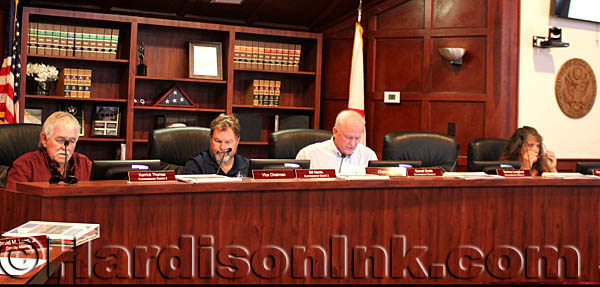
The four members of the Gilchrist County Board of County Commissioners present for the July 6 meeting are (from left) County Commissioner Kenrick Thomas, Vice Chairman Bill Martin, Chairman Darrell Smith and County Commissioner Sharon A. Langford. Commissioner Tommy Langford was out of the county on a planned vacation trip.
Story and Photo By Jeff M. Hardison © July 8, 2026 at 7:45 a.m.
All Copyrights Protected By Federal Civil Law
Do Not Copy and Paste to Social Media or Elsewhere
TRENTON – A solid waste transfer site is not a landfill. Trash is transported from there – not buried there.
Despite the difference, the Gilchrist County Board of County Commissioners are seeing and hearing the NIMBY (not in my backyard) reactions from some property owners -- as the commissioners continue striving at meetings to hopefully use a $4 million grant from Florida Legislature to help fund the construction of a new solid waste transfer site. A solid waste transfer site is known, too, as a “roll off site” because the residential (not commercial) waste and recyclable items collected there are rolled off to another place. From Gilchrist County, all of the residential garbage goes from these collection points to Union County.
The New River Solid Waste Association (NRSWA) was formed when Baker, Bradford and Union counties combined their resources to create the NRSWA in 1988. The association was formed to share the costs associated with solid waste disposal and resulted in the design and construction of the New River Regional Landfill (NRRL) – Florida’s first multi-county, regional facility.
The NRRL is an integrated solid waste management system located in Union County, and it operates disposal facilities for Class I solid wastes (which includes handling of special wastes such as waste tires and white goods) as well as 19 rural residential debris collection and recycling sites, which include garbage from Gilchrist, Dixie and Levy counties.
The solid waste transfer site to be built at one of two current sites under consideration is not going to have leachate going into the ground, although some people crying to the County Commission complain that solid waste transfer sites pollute underground aquifers. Actually, the garbage is not buried at the site. It is not a landfill.
The former Gilchrist County landfill is covered and monitored. The landfill for Gilchrist County trash for the past number of years is in Union County, where semi tractor-trailers take the garbage from Gilchrist County to Union County.
The solid waste transfer area is on a concrete platform where all fluids go into a tank. Then, that fluid is transported off of the site for disposal in Union County. If a person spilled a can of Coca-Cola on the site in Gilchrist County, then that liquid would drain and be hauled away. Commercial waste and hazardous materials are not collected at solid waste transfer sites. Metal, cardboard and other recyclable materials may be collected at these sites.
The NIMBY issue that Gilchrist County Commission members face currently is from some landowners near the property where the County Commission already has entered into an option to buy that particular land. The property owners in that area have complained that they do not want a solid waste transfer site anywhere near their homes, gardens, pastures or forests. Among the complaints is that their family has generations who have lived there over the previous years.
The County Commission solicited property owners in the county to find other possible locations – despite agreeing to exercise an option to buy that particular piece of property.
On Monday (July 6), Gilchrist County Chairman Darrell Smith, Vice Chairman Bill Martinand commissioners Kenrick Thomas and Sharon A. Langford spoke about the latest section of possible land for the future solid waste transfer site. Commissioner Tommy Langford was out of the county on a planned vacation trip.
The lion’s share of the first hour of that regular twice-monthly meeting showed Gilchrist County may pick future solid waste transfer site during Aug. 3 meeting. Of course, maybe they will continue to discuss matters rather than make a choice.
Gilchrist County may give away $5,000 for switching land buy choice. Gilchrist County may lose $4 million from slow action. Then again, the leaders may act and move along a definite path toward reaching a goal.
This attempt to buy land to build a new solid waste transfer site is seeing some other issues now. It is the time of year for creating next year’s annual budget. The clock continues ticking to qualify for a $4 million grant, even though the state government has given the county an extension already on securing a piece of land to accept the grant to partially fund the construction of a new solid waste transfer site.
The County Commission cancelled its regular July 20 meeting. It has several budget meetings planned.
Gilchrist County Administrator Bobby Crosby opened a lengthy discussion on July 6 regarding the new property to possibly be considered for the future solid waste transfer site.
The new offer of a place to put the solid waste transfer site is 22 and two-tenths acres, Crosby said, and it is located east of U.S. Highway 129 on Gilchrist County Road 232 where there is a dairy farm in the area. The seller wants $22,000 an acre, Crosby said, as of July 6. That piece, then, has a starting price of $488,400 total. Crosby said the county’s engineer has casually looked at the land, and at first glance it appears suitable from an environmental perspective.
However, just like the land the county has an option to buy already, the $30,000 or so needed to be invested in environmental studies has not been completed yet. Likewise, the rezoning process required for either property has not started.
There is a limited amount of available land suitable for the new solid waste transfer site, where a willing seller is ready to deal with closing the deal with the county. Out of all 67 counties in Florida, Gilchrist County ranks as the fifth-smallest county by land area. It covers approximately 349.68 square miles (about 224,000 acres) of land, according to the United States Census Bureau.
Crosby said one issue is finding a location away from established residences. Other factors considered are roads and traffic patterns. And the site must meet current standards for zoning and construction.
The current main transfer site is 30-plus years old, and it is not able to be expanded, unless the animal control part of it is moved. Relocated Gilchrist County Animal Control would cost $1 million or so. Some people complain that animal control is not needed, however state law mandates a certain minimal level of that service for nuisance animals in every Florida county.
Crosby, again, recited some of the history of this land-buying process that has not been concluded, including that four or five other sites have been considered already. Closing the sale on those other properties failed. Some properties were bought by other interests who outbid the county, and there even was a property owner who refused to sell to the county – just because the property would be used for the good of the whole community as a solid waste transfer site.
The current land where the county has an option to buy it is near State Road 47 and CR 340.
Commissioner Langford said she thought the seller at the newest location, east of U.S. 129, was willing to take $20,000 an acre, but now he wants $22,000 an acre.
After a comment by Commissioner Thomas, County Administrator Crosby said that whatever site is selected must be reviewed for environmental impacts. If the county finds land and builds a new solid waste transfer site, Crosby said, it must meet the current standards for any possible impact on neighbors.
“Somebody can say, ‘Well, the dairy is there,’ but the dairy has been there a long time,” Crosby said in regard to environmental impacts.
Commission Martin, like others, again stressed that this solid waste transfer site is NOT a landfill.
“It’s trash in, trash out,” Martin said. “Nothing will be buried there.”
Martin let listeners know that the debris does not sit and rot at a transfer site. It is brought in and then it is taken by semis quickly enough to not cause a health hazard from becoming rodent infested.
Gilchrist County Attorney David Miller “Duke” Lang Jr. used a map and a pointer to show everyone at the meeting that the newly proposed site has several residences on five-acre lots near to that site. He said when those people with established homes and the people who plan to build residences on those lots learn about the possible sale of that 22.2 acres for a future solid waste transfer site, then the County Commission will hear the same NIMBY complaints that they are hearing on the property where the county has an option to buy that land now.
The bottom line for everyone who lives near to either site now is that on Aug. 3 this issue is set to be heard – with that part of that regular meeting to start at 6 p.m. Both sites will be discussed.
And, even though the County Commission so far has failed to have one clear direction on a site – beyond establishing one option to buy with a deadline to close that deal or pay that property owner $5,000 for holding that land off of the open market for property sales, there is some hope officials will establish a clear path toward closing on a property purchase.
If the county fails to buy property, then it cannot accept the $4 million designated by the state to cover some of the cost of the next solid waste transfer site in this county.
For now, there is no back yard in Gilchrist County where a new solid waste transfer site is definitely to be located. And the county taxpayers will spend a certain amount of money on nothing more than advertising for meetings if things fall apart on Aug. 3. The county may possibly move forward with what is required as a first tangible step to bring that project to fruition. And if the county leaders choose the newest possible site, then the landowner who is currently involved with possibly closing the sale on his property will accept $5,000 as part of the process.
On Aug. 3, the County Commission may choose to have an option to buy the second piece of property, too, with some deadline for decision on closing that purchase to be made, or to pay some fee for not exercising that option.
And the county leaders may choose to seek still more land to possibly purchase.
Free enterprise thrives
in Tri-County Area
on USA's 250th Anniversary
Gray Construction Services
heralds 25th year of building

(from left) Dressed as President George Washington is Kaleb Barbieri; dressed as Betsy Ross is Sadie Hachman; and as Lady Liberty – The Statue of Liberty – is Gina Nobles. They were among the people helping celebrate Independence Day in Old Town on Saturday (July 4) at the Marathon Convenience Store and Hardees Restaurant.
Story and Photos By Jeff M. Hardison © July 4, 2026 at 8:15 p.m.
Gray Construction Services Graphic copied from LinkedIn
All Copyrights Protected By Federal Civil Law
Do Not Copy and Paste to Social Media or Elsewhere
TRI-COUNTY AREA – Stoney Smith is a sixth-generation Floridian who has served on the Chiefland City Commission and the Fanning Springs City Council in years past.
In addition to that, Smith, as a local businessman has embodied the true spirit of free enterprise as an American.
A staunch Republican, his commercial interests in the Tri-County Area, and beyond, provide jobs for people as well as opportunities for consumers to purchase products and services.
On Thursday (July 2), Smith did a couple of things that show he enjoys giving back to the community. First, he fed firefighters. Second on June 2, he called a member of the local press corps.
Smith noticed a fire vehicle that is part of the Florida Forest Service (a division of the Florida Department of Agriculture and Consumer Services) as it turned to go south on U.S. Highway 19 at the traffic light in Old Town (Dixie County) shortly after 8 a.m. on the Fourth of July 2026.
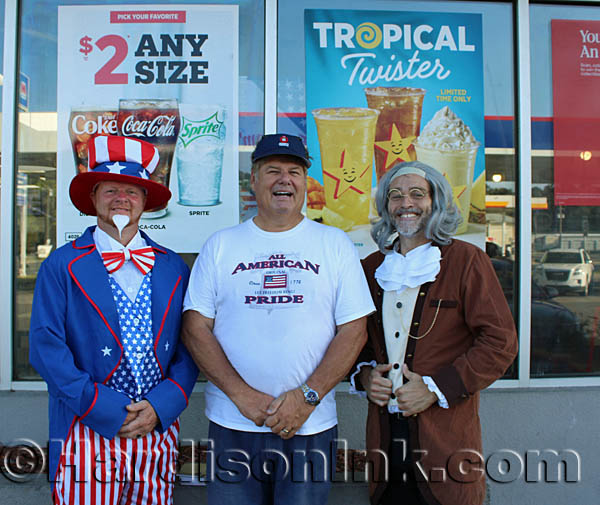
(from left) Dressed as the Uncle Sam is Sam Byrd, dressed as Stoney Smith, Republican business owner, is Stoney Smith, and dressed as Benjamin Franklin is Coleton Vickers. Smith helped several people start their Fourth of July festivities by having some fun in Old Town and enjoying sales as well as entering a contest to win prizes.

Among the items of décor in the Hardees of Old Town is this wall with red, white and blue balloons as well as information about some American history.
“Now, there’s some real heroes” Smith said to daily news website editor and publisher Jeff M. Hardison as the two businessmen stood in the Marathon-Hardees parking lot on the morning of the Fourth of July 2026.
People who know Smith realize that one topic will switch quickly to another topic in conversations with him. Also, while speaking with him, it can be a challenge to get a word in edgewise. Hence, when he noticed the truck, the conversation switched from the celebration at the minute to another happy event a couple of days earlier.
He went on to mention that 14 firefighters were provided with submarine sandwiches and hoagies at the Usher Fire Tower, a lookout structure operated by the Florida Forest Service (formerly the Florida Division of Forestry), located at the Usher Work Center on U.S. Highway 19, south of Chiefland.
This tower is among those that serve as a vital tool for wildland fire observation in the region. The Florida Forest Service utilizes a network of these steel towers to spot wildfires and manage the state’s timberlands.
Smith said he wanted to do something to let some members of the team that battles against wildfire know their work is appreciated.
Meanwhile, back to another of the busy businessman’s actions on July 2 leading to the July 4 meeting of Smith with Hardison, Smith had called the journalist to invite him to the gas station, convenience store and restaurant where he was again giving back to the community as part of the celebrants of Independence Day.
That call was cut short, though, because the publisher had another incoming call from another business owner. Smith had been speaking about when he served recently as a moderator during a Republican Party event at First Baptist Church of Bronson, where political candidates enjoyed chances to speak to people in attendance at that get-together. Hardison told the man that he regrets not being able to attend that event, but that he planned to be at the one in the Tommy Usher Community Center, where the City of Chiefland is having a similar forum this month.
The proverbial bottom line was that Hardison learned about Smith’s plan for a local celebration of the 250th Anniversary of the United States of America becoming a nation. From 8 a.m. until noon, on the Fourth of July, 2026, at the Marathon gas station and convenience store, and the Hardees in Old Town, 25807 S.E. U.S. Highway 19 (the southeast corner of U.S. 19 and Southeast Dixie County Road 349 {aka Highway 349}), the holiday was to be celebrated.
Hardee’s is a major American fast-food restaurant chain known for its charbroiled Thickburgers (Angus Burgers) and freshly baked, “Made from Scratch” biscuits.
Hardison showed up shortly after 8 a.m. on July 4, where he took advantage of a few photo opportunities to herald the celebration of American freedom from British control and the continuation of free enterprise. Thanks to Smith, the journalist had the start of some coverage of the day and night in the Tri-County Area of Dixie County, Levy County and Gilchrist County.
Not only were there people dressed for the occasion, but there were items on sale at this business, too. Also, there was a contest where people could win a $500 gift card for gasoline, inflatable rafts, a bicycle and more – just by signing up to be in the contest.
Visitors could accept free bead necklaces of red, white and blue if they wanted as well. Hardison accepted a blue set of beads that were as blue as the background for the stars that are on the American flag.
Inside the Hardee’s there was a wall with some patriotic figures from early American history. On a television screen at another side in the Hardees, there was an ongoing video running with a set of photographs from a recent trip to Washington, D.C., where the leader and chair of the Dixie County Republican Executive Committee -- Jovante' Teague – had visited, and returned with photos.
The additional officers for the Dixie County Republican Executive Committee include Committeeman Hunter Allen and Committeewoman Nicole Walker.
Smith let the visiting journalist know that he anticipated some local elected leaders to be dropping by the celebration of the Fourth of July at this business location. The journalist had to leave, though, due to other duties calling for his attention.
Gray Construction Services
heralds 25th year of building

This graphic taken from a LinkedIn post, shows Gray Construction Services celebrating this day as well.
And there is another Tri-County Area business that has happy news on this Fourth of July, too.
This Fourth of July marks a milestone unlike any other for the nation -- 250 years of American independence.
And for Gray Construction Services, it’s also a milestone -- 25 years of building!
A quarter century ago today (Saturday, July 4), Gray Construction set out to be a general contractor who its clients could count on, across commercial, institutional, industrial and infrastructure projects.
Today, the structures that licensed, bonded and insured general contractor has helped bring to fruition stand as a testament to the people behind them -- the crews, the partners, and the clients who trusted Gray Construction Services with their vision.
As America celebrates 250 years of building something greater, Gray Construction Services is proud to mark 25 years of building alongside the communities it serves, and they noted they are “just getting started.”
“Happy Independence Day from all of us at Gray Construction Services,” they noted on a LinkedIn message today.
Beyond the stories of business success by Smith and Gray, there are a million other Tri-County Area ventures that help keep the communities going – including those involved in agriculture, aquaculture, tourism and some manufacturing.
Publisher’s Note: And as some people who know Hardison will be able to guess may be mentioned -- there is one daily news website where business interests can advertise for the best return on investment of ad dollars in Florida -- HardisonInk.com.

200th Performance
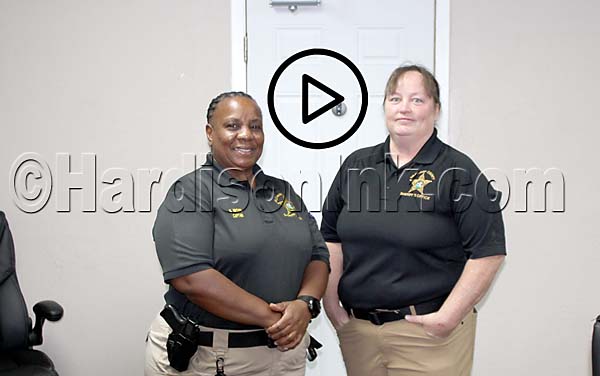
Gilchrist County Sheriff's Office Capt. Sheryl Brown (left) and GCSO Evidence Manager Jennifer Williams sing the HardisonInk.com Jingle on Thursday (July 9), just before the meeting of the Gilchrist Prevention Coalition at the GCSO in Trenton. Jeff M. Hardison asks people to sing the jingle, and some of them agree to sing it. (Thanks people!) CLICK ON THE PICTURE ABOVE TO SEE AND HEAR THE VIDEO ON YouTube.com. The very first person to sing the jingle was Danesh “Danny” Patel of Danny’s Food Mart in Chiefland in March of 2013. HardisonInk.com started as a daily news website on Feb. 1, 2011.
Photo and Video by Jeff M. Hardison © July 9, 2026, 2026 at 4:45 p.m.
All Rights Reserved - Do Not Copy And Paste Anywhere Else




Click On Ads To Visit Websites

Click On Ad To Visit Website.

Click On Ad To Visit Website.

Click On Ad To Visit Website.

Click On Ad To Visit Website.

Click On Ad To Go To Website.

Click On Ad To Visit Website.


Click On Ad To See Website.

Click On Ad To See Website.

Click On Ad To Visit Website.


Click On Ad To Go To Website.

Click On Ad To Visit Website.

Click On Ad To Visit Website.

Click On Ad To Visit Website.

Click On Ad To Visit Website.

Click On Ad to Visit Website.

Click on Ad To Visit Website.


Please Click Above
To See Ad Rates and Coverage

Please Click On The Above Ad
To Go To The Archived
Stories, Photos and Videos.