
Organizations Where HardisonInk.com Is A Member
CLICK HERE TO SEE MEMBERSHIP ADS
Watermelon fest parade
includes candidates and more
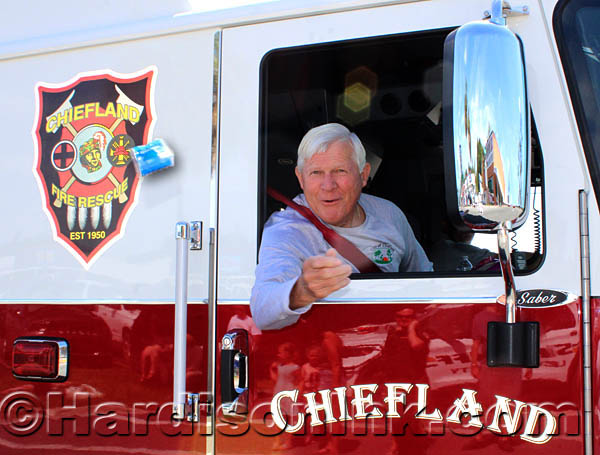
Chiefland Vice Mayor Norman Weaver rides on the passenger side of Chiefland fire truck in the parade. The blue square in the photo near the symbol for Chiefland Fire Rescue is one of the pieces of candy he threw at the moment the photo was taken.
Story, Photos and Video
By Sharon and Jeff M. Hardison © June 7, 2026 at 3:15 p.m.
All Copyrights Protected By Federal Civil Law
Do Not Copy and Paste to Social Media or Elsewhere
CHEIFLAND – The 2026 Chiefland Watermelon Festival was very well watched by people lining U.S. Highway 19 in Chiefland on Saturday morning (June 6).
More Below This Ad

Click On Ad To Visit Website
Spectators saw candidates in every contested race to be decided by Levy County voters, and for one Florida House of Representatives’ seat. There was a very strong showing of John Deere tractors of every size.
Parade participants threw lots of candy, some beads, handheld fans and one young man from Farmer’s Home Furniture of Chiefland was walking the route and giving away frozen ice pops.
There was no marching band. There were pageant winners from the Chiefland Watermelon Festival, the Chiefland May Day, the Newberry Watermelon Festival and a strawberry festival.
There were not many floats. There was one monster truck. The weather was relatively nice with partly cloudy skies and temperatures in the low to mid- 80-degree Fahrenheit range.
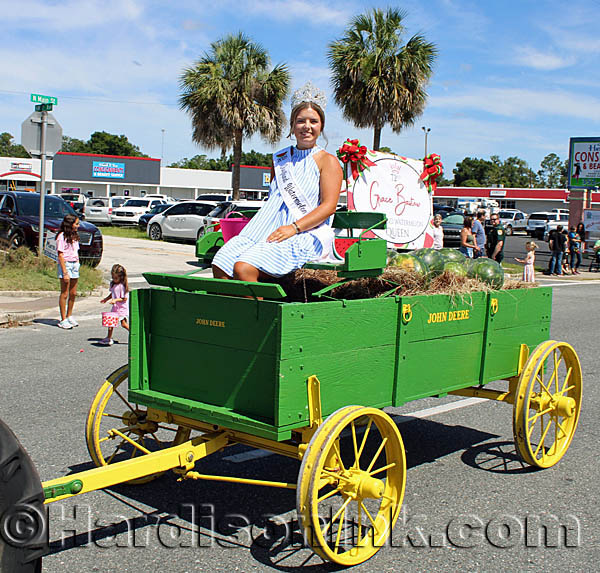
2026 Chiefland Watermelon Festival Queen Grace Bastow rides in a John Deer trailer that includes hay and watermelons.
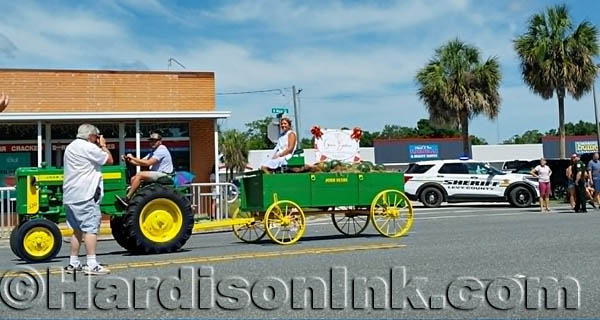
An intrepid daily news website publisher takes a picture of 2026 Chiefland Watermelon Queen Grace Bastow as she rides in a John Deer trailer that includes hay and watermelons.
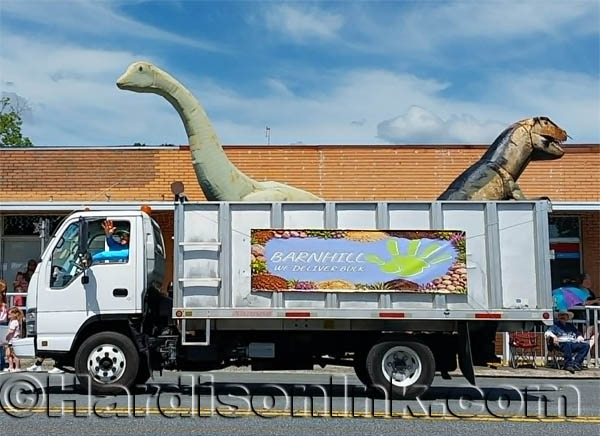
Barnhill Garden Center (also known as Barnhill Landscapes) brought a couple of dinosaurs to the parade this year. This entry is always a big hit with children and adults.
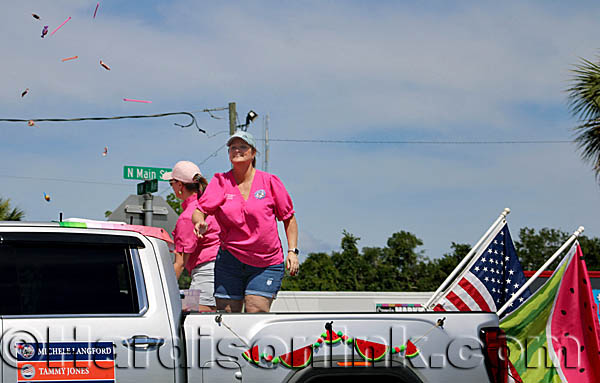
Candy is seen flying in the air from the hand of Levy County Tax Collector Michele Langford as Levy County Supervisor of Elections Tammy Jones throws cand toward children on the other side of the vehicle. Notice the American flag and the watermelon flag at the back of the truck.
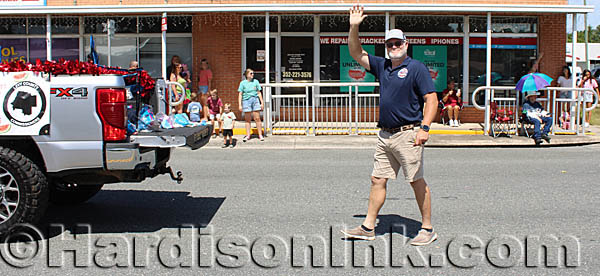
Outgoing Levy County Commissioner Rock Meeks (Dist. 2) walks in his last Chiefland Watermelon Festival as a county commissioner, unless he qualifies and is elected again in the future. As of June 5, he seemed to be on his planned course to wrap up his service to people in this capacity with the end of this term in office.
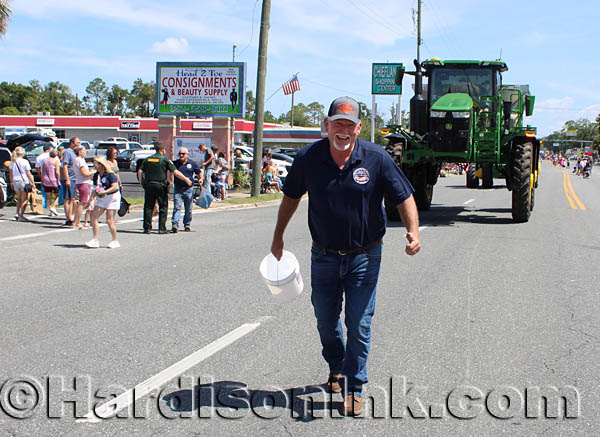
Levy County Commission Chairman Tim Hodge (Dist. 4), a Republican, walks in the parade on Saturday. Hodge has indicated his intent to seek reelection.

As one of the two candidates currently indicating a plan to be elected as Levy County Court judge, Darla Whistler is seen walking in the parade. Like Levy County Court Judge Luis Bustamante, who is the other candidate, Whistler had a relatively strong presence of vehicles and supporters in the parade.
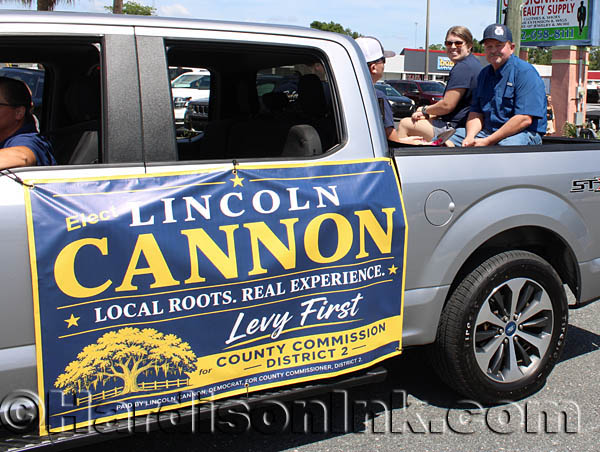
Lincoln Cannon, the Democrat seeking to be elected to Levy County Commission (Dist. 2), rides in the back of a pickup truck in the parade.
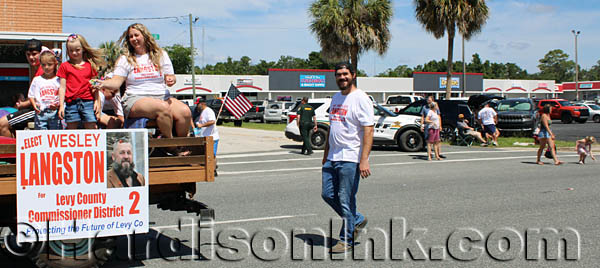
Wesley Langston, one of the two Republicans seeking to be elected to Levy County Commission (Dist. 2), walks behind a pickup truck in the parade.
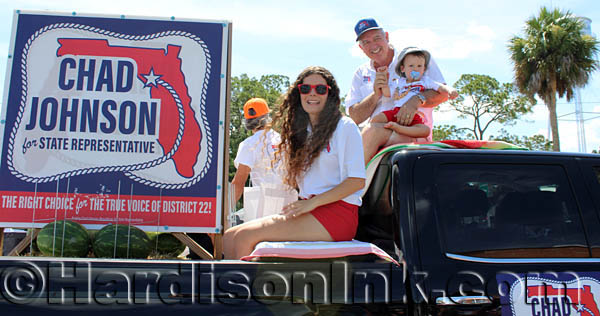
Chad Johnson, a Republican seeking reelection to the Florida House of Representatives (Dist. 22) sits on the roof of a pickup truck in the parade.
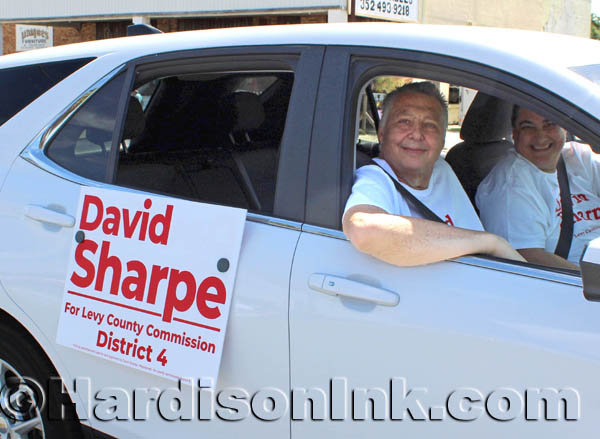
David Sharpe, a Republican seeking to be elected to the Levy County Commission (Dist. 4) post, rides in a car in the parade.
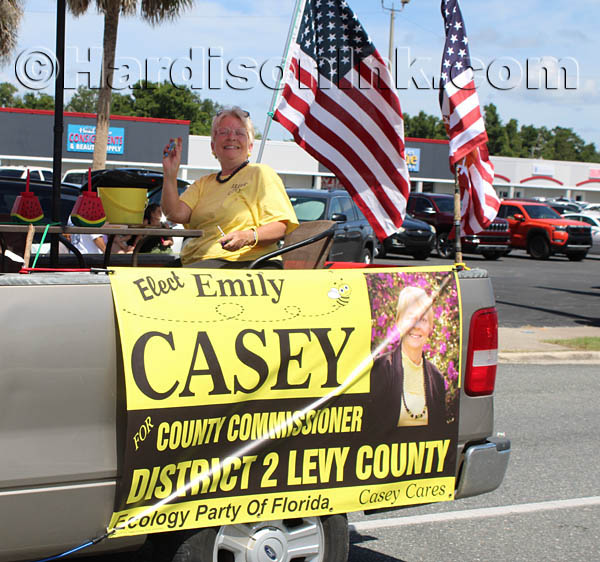
Emily Case, a member of the Ecology Party who is seeking to be elected to the Levy County Commission (Dist. 2) post, rides in the back of a well-decorated pickup truck in the parade.
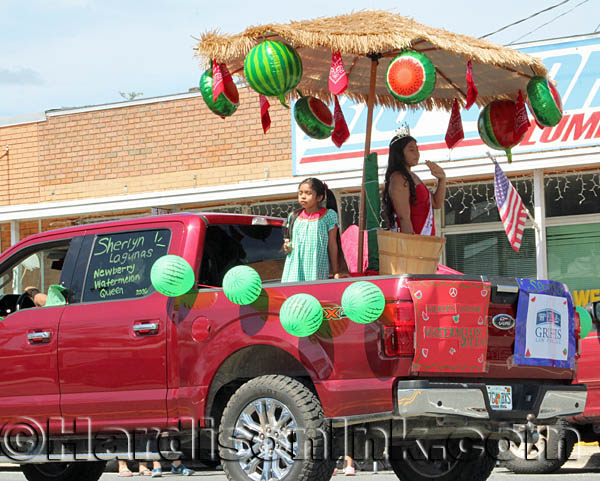
2026 Newberry Watermelon Festival Queen Sherlyn Lagunas rides in a vehicle that is so decorated that it could not be missed.

2026 Miss Strawberry Queen of North Florida Alyssa Cason, 2026 Miss Strawberry Princess of North Florida, Saige Waters and 2026 Miss Strawberry Shortcake of North Florida Vivian Hunt are among the many, many pageant winners gracing the 2026 Chiefland Watermelon Festival. Seen here on a truck near the end of the parade route, they show the style that so many of the various 'royalty' of the day demonstrated.

Katheryn Lancaster, a financial planner who has opened an office in downtown Chiefland, rides in a convertible in the parade.

A monster truck from Kenneth Bell’s Tree Service is the only monster truck in the parade.

Kenneth Bell’s son Steven drives the monster truck while other family members, and perhaps others, ride in and on the vehicle to help everyone celebrate the 2026 Chiefland Watermelon Festival.
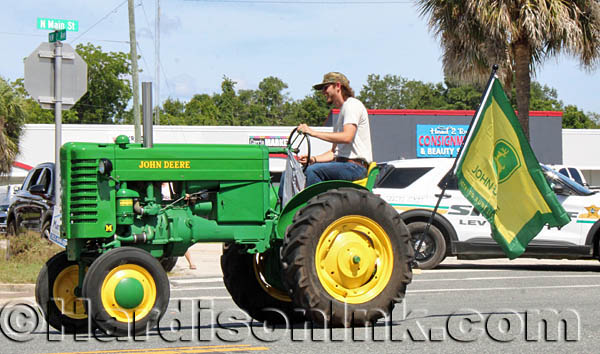
One of the many John Deere tractors in the parade is seen.

Another one of the many John Deere tractors in the parade is seen.

This video shows some of the many John Deere tractors in the parade. Click on the PHOTO to see and hear the tractors.
Video By Jeff M. Hardison – All Rights Reserved – Not for republication

An ambulance from HCA Florida Healthcare is seen in the parade. There are no hospitals of trauma centers in Levy, Dixie or Gilchrist counties. So, all of the ambulances that transport people from the Tri-County Area are among the vital aspects required to saving lives in this part of Florida.
May Day Pageant Winners Shown
Below are the photos of the winners in the 2026 May Day Pageant.
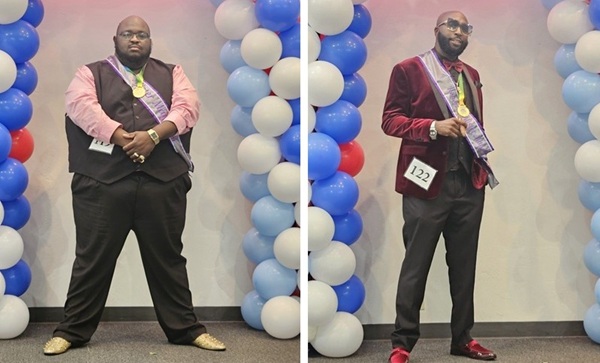
Mr. May Day Demonds Jackson (left)
and Mr. Classic May Day - Larry Johnson

Little Miss May Day - Ava Schuler (left)
and Miss Petite May Day - McKenzie McCellan

Miss Teen May Day - Fatimah Mannah (left)
and Ms. Classic May Day - Darnitha Johnson
Information and photos were provided
By May Day Committee President Alice Monyei
Published June 3, 2026 at 3 p.m.
May Day 2026 opens
with a prayer for unity
New sign commemorates
renovation of Eddie Buie Park
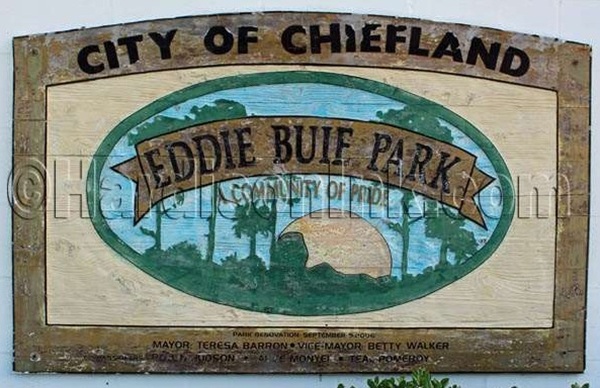
This photo from the 2020 story exclusively first published in HardisonInk.com about the addition of a memorial wall erected in Eddie Buie Park in the year 2020, shows how the 2006 sign needed replacement as long as six years ago. The Eddie Buie Park renovation was completed on Sept. 9, 2006, when the Chiefland City Commission was comprised of Mayor Teresa Barron, Vice Mayor Betty Walker, and city commissioners Rollin Hudson, Alice Monyei and Teal Pomeroy.
Photo From HardisonInk.com archives-All Rights Reserved
Story, Photos and Video By Jeff M. Hardison © May 31, 2026 at 4 p.m.
All Copyrights Protected By Federal Civil Law
Do Not Copy and Paste to Social Media or Elsewhere
CHIEFLAND – The 2026 Annual May Day event in Chiefland on Saturday (May 30) opened with a prayer for unity as well as the unveiling of a new sign that replaced the 20-year-old sign.
The whole day in Eddie Buie Park went as anticipated from its traditional roots. The Annual Chiefland May Day Festival’s foundation, and its cornerstones go back decades in time – with its heritage reflexive of American history and Florida history.
Pastor Michael Dockery opened the 2026 Chiefland May Day event with a prayer. The dozen-plus initial hosts and guests of the day joined hands in a prayer of unity. Minister Dockery prayed for the wellbeing of whole city of Chiefland with the unity of purpose helping all of the area’s residents and visitors.
Unveiling The New Sign
The 10 a.m. unveiling was under a completely cloud-covered sky with a 79-degree Fahrenheit temperature and about 100 percent humidity.
May Day Committee President Alice Monyei, a former Chiefland City Commissioner whose name is among those on the sign, was joined by Chiefland City Manager Laura Cain, who was the deputy city clerk of Chiefland 20 years ago, when the park was named. They are the people who unveiled the new sign.
Both ladies gave brief off-the-cuff speeches as they pulled away the tarp with one on each side, united in their mission of the moment. And then, it was seen.
The 2026 members of the Chiefland May Day Committee are President Alice Monyei, Vice President Valerie Buie, Secretary Bernadette Brown, Treasurer Cecilia Jones, Chaplain Deacon Jerrlle Davis, Bronson Town Councilman Franklin Schuler Jr. and Keisha Depeiza. Honorary May Day Committee members are Pastor Robert “Bob” Williams, James “Jimmy” Mitchem and Rawl Depeiza.
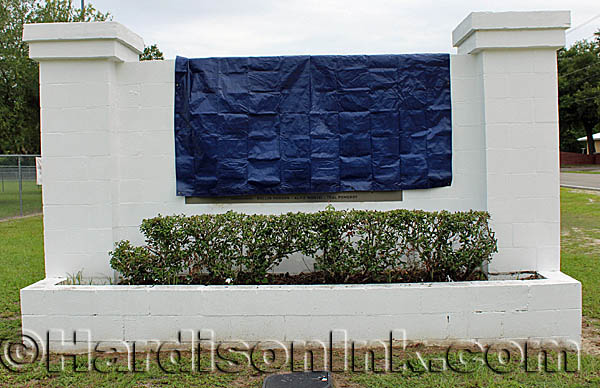
The sign is covered before being shown to the world.
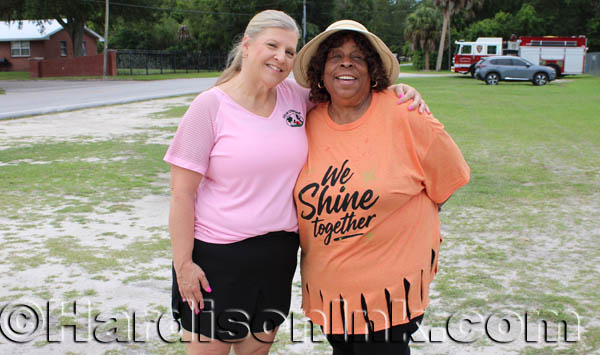
Chiefland City Manager Laura Cain (left) and former city commissioner, archivist and May Day Committee President Alice Monyei are seen mere minutes before the unveiling of the new sign.
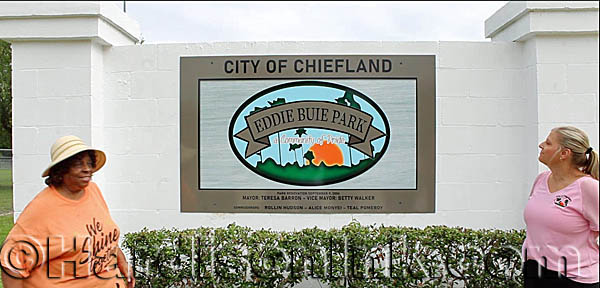
May Day Committee President Alice Monyei (right), and City Manager Laura Cain stand next to the just-unveiled new sign.
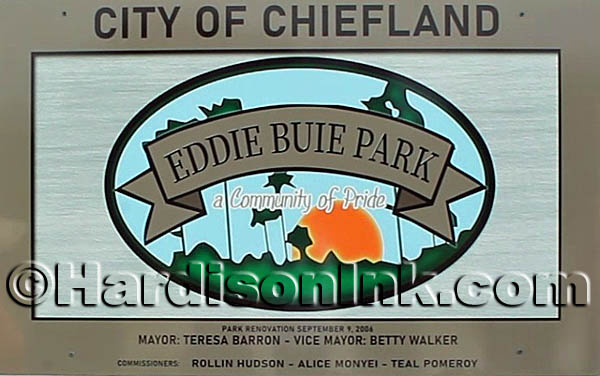
This close-up view shows the fabulous work by B4 Signs of Williston at creating the new sign.
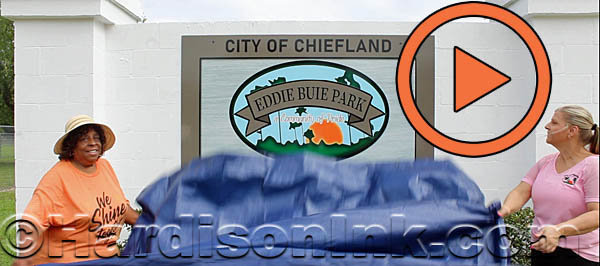
This is a video of the ceremonial unveiling of the new sign for Eddie Buie Park in Chiefland on Saturday morning (May 30), and it includes the speeches by former Chiefland city commissioner and May Day Committee President Alice Monyei and Chiefland City Manager Laura Cain. To see and hear the video, click on the PHOTO.
Video By Jeff M. Hardison – All Rights Reserved
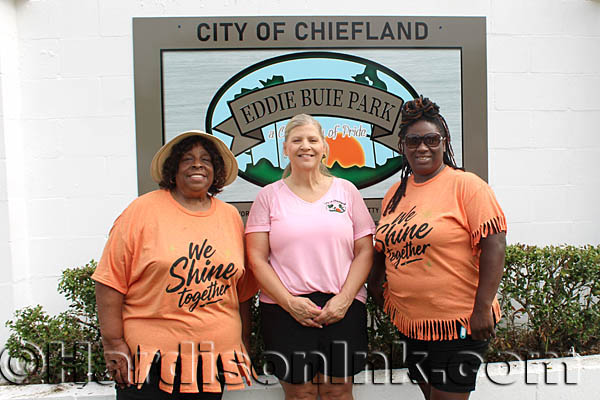
After the new sign was shown to the world, there were some opportunities for photographs. First up were (from left) May Day Committee President Alice Monyei, Chiefland City Manager Laura Cain and May Day Committee Treasurer Cecilia Jones. Monyei was among the Chiefland City Commission members 20 years ago.
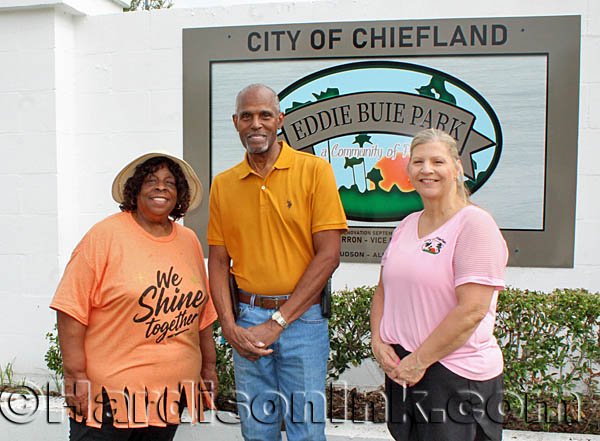
Seen here in front of the new sign are (from left) May Day Committee President Alice Monyei, minister Michael Dockery and Chiefland City Manager Laura Cain.
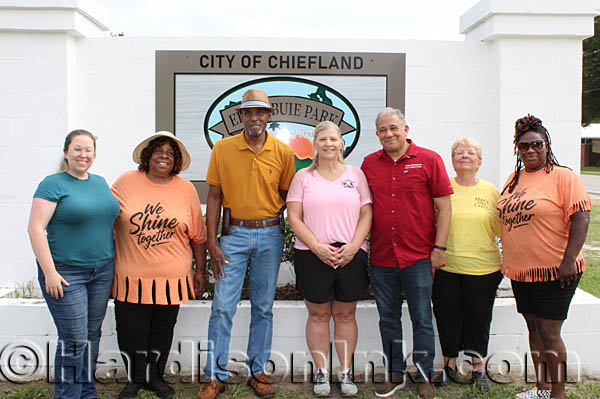
Seen here in front of the new sign are (from left) Amanda ‘Amy’ Jane Trask, the Democrat who is seeking to be the Florida House of Representatives member for District 22 (which includes Levy County), Alice Monyei, Minister Michael Dockery, City Manager Laura Cain, Levy County Court Judge Luis Bustamante, Emily Casey - the Ecology Party member seeking to be the next Levy County Commissioner for District 2, and May Day Committee Treasurer Cecilia Jones.
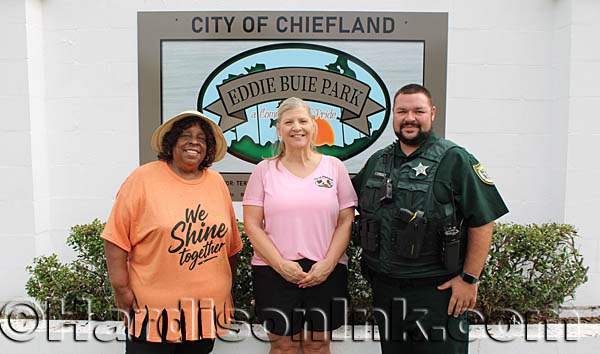
From the ‘law’ side of a ‘law and order theme’ of photo opportunities of the day, seen here (from left) are Alice Monyei, City Manager Laura Cain and Levy County Sheriff’s Deputy Z. Corman.
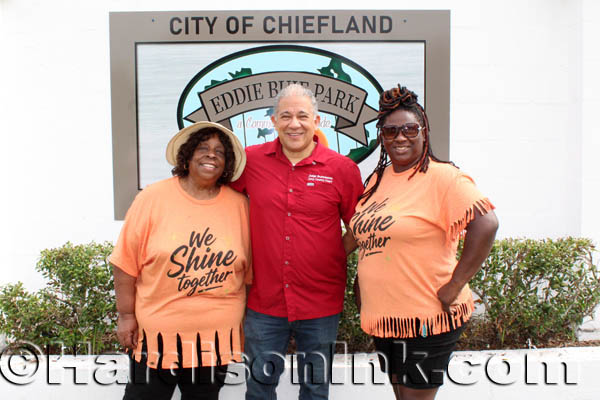
From the ‘order’ side of the ‘law and order theme’ of photo opportunities of the day, seen here (from left) are May Day Committee President Alice Monyei, the Honorable Levy County Court Judge Luis Bustamante and Chiefland City Manager Laura Cain.
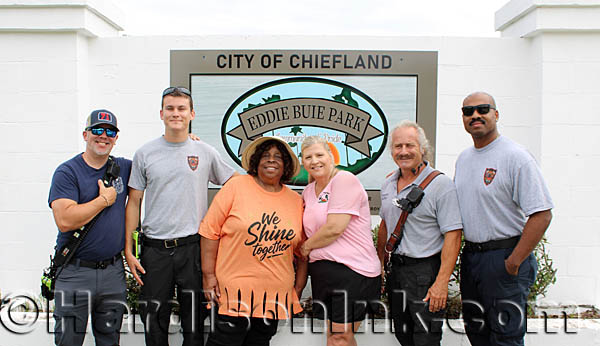
Representing the Chiefland Fire Rescue Department in photo opportunities of the day, seen here (from left) are Firefighter Brad Slaughter, Capt. (Firefighter-Paramedic) Luke Stockman, Alice Monyei, Laura Cain, Firefighter-Paramedic Paul McCarthy and Firefighter-EMT Lamar Louis.
In her speech for the unveiling of the new sign, May Day Committee President Monyei said, “A long, long, long, long time ago,” the first sign was designed by Edward Nelson, the grandson of Eddie Buie, for whom the park is named. She pointed to the house where the late Mr. Buie lived. And the 69-year-old woman then spoke about being a 5-year-old girl who lived on the corner nearby.
Monyei would walk across the street to the school that used to exist where the park is today.
“This is where the segregated African American school was before it burned,” Monyei said.
Monyei said the May Day Committee asked City Manager Cain if the city would restore and refurbish the sign. Cain said she would have it done, Monyei said, and Cain did “a great job.”
Cain let the listeners know this 20-year-old sign needed replacement.
She noted that B-4 Signs of Williston is the company that made the new sign and they “did a fabulous job.”
As Cain spoke about sending the B-4 Signs company what the old sign looked like to restore it like that, a Florida Mockingbird started signing in the background. Cain said the residents of, and visitors to, Chiefland “love this park and want to keep it as beautiful as it is.”
The sign notes the City of Chiefland’s Eddie Buie Park is part of “a Community of Pride.”
The park renovation was completed officially on Sept. 9, 2024, When the Chiefland City Commission was comprised of Mayor Teresa Barron, Vice Mayor Betty Walker, and commissioners Rollin Hudson, Alie Monyei and Teal Pomeroy.
History Of May Day
The unveiling of the new sign on May 30 was in keeping with a tradition at Eddie Buie Park, where the old Chiefland Jr. High School once stood.
As an older tradition, before the advent of the May Day Group Inc., the Chiefland Men’s Club called this annual celebration the Chiefland May Day Extravaganza.
For instance, The 29th Annual May Day Extravaganza, sponsored by the Chiefland Men's Club, was on Saturday, May 26, 2012, from noon to 6 p.m. at Eddie Buie Park, as noted in a previous HardisonInk.com story.
While this event on Saturday (May 30, 2026) would have been the 43rd Annual Chiefland May Day Extravaganza, the global COVID-19 pandemic caused some 2020 events to go by the wayside, and as may have been noticed “Extravaganza” is out of the title and the Chiefland Men’s Club no longer serves as the hosting group. Hence, there may be a different numeric value to this Chiefland May Day Festival.
The celebration in 2026 comes from the end of a war 161 years ago.
On May 20, 1865, Union Brigadier General Edward McCook read the Emancipation Proclamation from the steps of the Knott House in Tallahassee, officially emancipating enslaved Black people in Florida, according to records in the Office of the Florida Secretary of State. This landmark announcement occurred two years after United States President Abraham Lincoln’s initial proclamation, those records show. This was 11 days after the official conclusion of the Civil War.
The American Civil War effectively ended on April 9, 1865, when Confederate Gen. Robert E. Lee surrendered his Army of Northern Virginia to Union Gen. Ulysses S. Grant at Appomattox Courthouse in Virginia, according to the United States National Archives.
May Day Committee President Monyei noted in the 2026 May Day Pageant booklet that the Chiefland May Day celebration originated more than 60 years ago at what was then Chiefland Junior High School, which served as the community’s segregated African American educational pillar.
Each year, back then, she said, families and neighbors gathered together to memorialize this historic turning point in Chiefland history through vibrant festivities, including traditional maypole dancing, music and athletic competitions.
After the school burned down in 1967, the tradition faced a temporary interruption, she noted.
The site was subsequently acquired by the city of Chiefland, cleared and then it was transformed into a public park. Later, it was dedicated as Eddie Buie Park in honor of a distinguished local resident. This park has become the place for this annual celebration in Chiefland.
Under the stewardship of the Chiefland Men’s Club and the leadership of minister John Henry Donaldson, a former mayor of Chiefland, the annual celebrations were successfully reinstated years ago.
After a hiatus, the festival entered a new era of growth in 2020. Led by former City Commissioner Monyei, the May Day Committee sought to preserve the event’s heritage while reintroducing lost traditions.
The committee orchestrated the return of the Chiefland May Day Beauty Pageant, resurrecting a community cornerstone that had been dormant for 55 years.
This year heralds the fifth year since the restart of the pageant. The Chiefland May Day event “stands as a testament to the resilience, history and unity of the Chiefland community,” Monyei has noted.
Indicators of Another Great Event
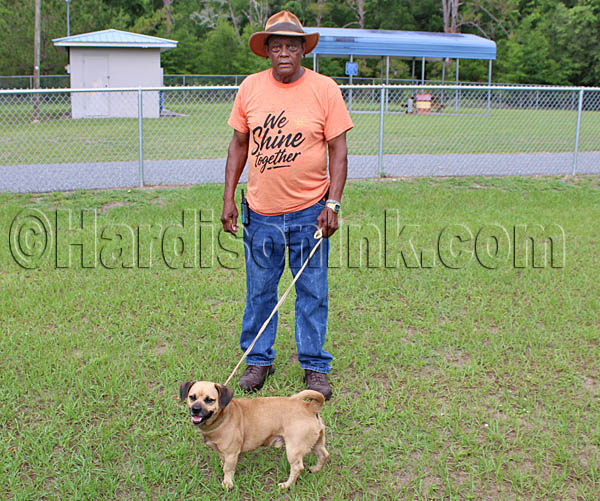
James Mitchem and his dog Ace, a 5-year-old Beagle-mix, help people park in the park.
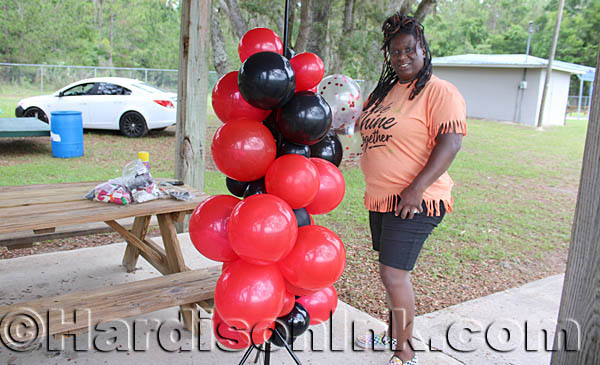
May Day Committee Treasurer Cecilia Jones creates balloon decorations for the event.
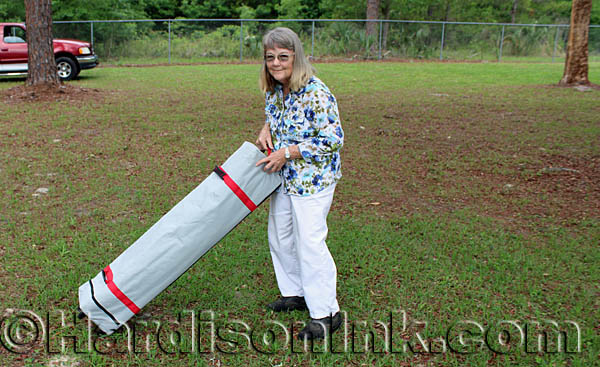
Kristine Switt, the chair of the Levy County Democratic Executive Committee (DEC), rolls a 39-pound container for a tent onto the park grounds. Switt was not serving as a Democrat but was able to work as a member of a third-party voter registration organization, which the DEC is.

Cynthia Jackson, owner of Unique Soul Food, is seen next to the food trailer. She served oven stew chicken, BBQ chicken, collard greens, yellow rice, seamed cabbage, green beans, red beans, black-eyed peas and more. One of the delicious plate deals was clams with seasoned corn-on-the-cob, with boiled seasoned potatoes.
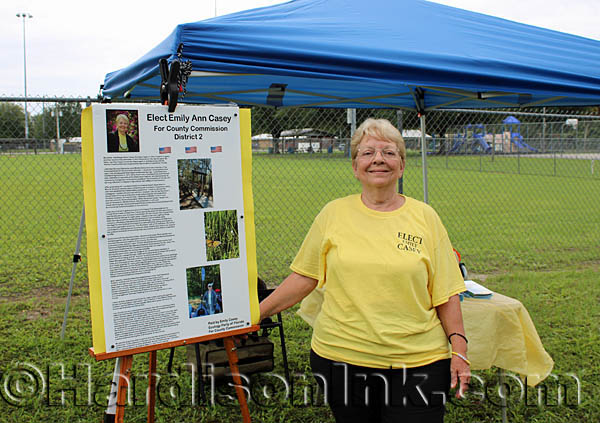
One of the first local candidates to put up a tent was Emily Casey (ECO), a candidate for Levy County Commission District 2.
Once again, the festival had the earmark of another great annual gathering.
After the new sign was uncovered, there was music planned for playing by DJ Garett Collins, as well as food, vendors, a May pole activity and other games.
And some candidates seeking election in the primary and general elections were there to speak to the voters and other members of the public. From the 2026 May Day Beauty Pageant, there were the introductions of the “Kings and Queens” as well as the “People's Choice.” The celebration was scheduled to continue with children’s fun time, and a dance contest.
Potentially coming soon – results from the 2026 May Day Beauty Pageant, celebrating five years under the May Day Group Inc.
To see the May 30, 2025 story under the headline -- Chiefland city commissioner (the late Chris Jones) shares his thoughts about racial discrimination at meeting; Street to be paved, click HERE.
To see the May 20, 2024 story under the headline -- Candidates speak at May Day event in Chiefland, click HERE.
To see the May 19, 2024 story and photos under the headline -- Chiefland’s May Day 2024 shows plenty of food vendors, click HERE.
To see the May 29, 2023 photo montage under the headline – May Day 2023, click HERE.
To see the May 30, 2021 story and photos under the headline – Chiefland May Day 2021 provides chances for food and fun, click HERE.
To see the May 30, 2020 story and photos under the headlines -- EXCLUSIVE First On HardisonInk.com; Memorial wall unveiled at Eddie Buie Park; Ernest A. Haile Jr. Memorialized, click HERE.
Watermelon Buses Roll

On Tuesday afternoon (May 26), the search for an annual watermelon bus picture to publish in the 16-year-old daily news website began. A visit to LCG Farm in Levy County, where a previous story and photos were completed as people packed watermelons into heavy-duty cardboard boxes years ago, led to Brian Fayet helping in the search. A short ride to L&S Farms showed John Parrish, owner, helping in the completion of the mission of taking a picture from inside a revised school bus loaded with watermelons. These buses are seen again this year transporting thousands of watermelons in the Tri-County Area to places where they are put into boxes, and those boxes are put into semi tractor-trailers, which carry them somewhere else, eventually showing up in grocery stores everywhere. John Parrish's father Johnny Parish, 73, was present at the L&S Farms and provided lots of jokes for the visiting journalist and the journalist’s wife during the relatively short visit that afternoon.
To see the May 28, 2020 photos and video under the headline -- Watermelon Harvesting, click HERE.
To see the June 2, 2017 photos under the headline -- Friday Watermelon Harvest, click HERE.
Photo By Jeff M. Hardison © May 27, 2026 at 10 a.m.
All Rights Reserved
Quarterly reports run
for more than an hour
Novice economic development manager
gives lively presentation
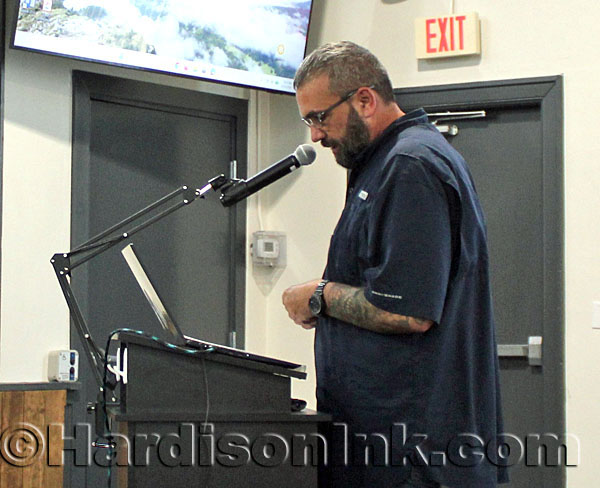
Levy County Provisional Building Official Bernard ‘Bo’ Cox provides the County Commission with quarterly information regarding development.
Story, Photos and Video By Jeff M. Hardison © May 21, 2026 at 2 p.m.
All Copyrights Protected By Federal Civil Law
Do Not Copy and Paste to Social Media or Elsewhere
LEVY COUNTY – The five members of the Levy County Board of County Commissioners asked for it, and they got it.
In the county manager method of government, as exists in Levy County, it separates political leadership from administrative execution. The qualified voters elect the five-member County Commissioners to set policy. Those leaders hire a professional, non-partisan county manager to oversee day-to-day government operations and staff. In Levy County, those five elected leaders told the county manager they wanted to see reports from the department heads regarding progress made and the like.
Those five people are Commission Chairman Tim Hodge, Vice Chairman Charlie Kennedy and commissioners Johnny Hiers, Rock Meeks and Desiree Mills. Levy County Manager Mary-Ellen Harper instructed department heads to provide one-minute synopsis from 22 distinct departments and offices.
The May 19 presentations provided quite a show of success for the county in that quarter of a fiscal year. What may be considered the liveliest part of that meeting was when Levy County Economic Development Manager Landon Scruggs Harrar gave his presentation. He essentially kept his delivery to the one-minute standard County Manager Harper had hoped to meet.
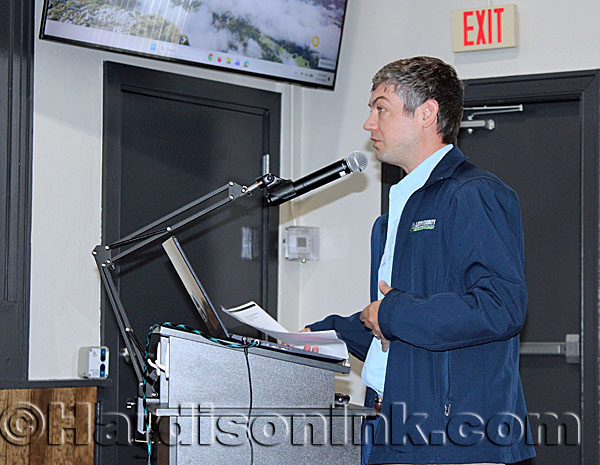
Levy County Economic Development Manager Landon Scruggs Harrar
Across the 20-plus departments, every department leader gave even more than anticipated to the five elected leaders who chose a county manager to lead those on-the-ground efforts.
Levy County Economic Development Manager Harrar, a former employee of the Gainesville Area Chamber of Commerce, is in the recently created position that happened after the Nature Coast (Levy County) Business Development Council (NCBDC) dissolved. Later in the meeting of May 19, Harrar spoke to the County Commission about creating a different version of the NCBDC, which may be named the Levy County Economic Development Advisory Board (LCEDAB).
Harrar graduated with a bachelor’s degree in communication from Indiana University of Pennsylvania, where according to the job application he filled in, he completed 120 credit hours of classes. He also completed 80 more credit hours of classes at the Broadcasting Institute of Maryland.
There is no record in his job history of economic development, per se, beyond the Gainesville Area Chamber of Commerce. Harrar’s job application shows him noting that he completed an introduction to economic development course at the University of South Florida (USF), and he has completed "Leadership Gainesville” and the Dale Carnegie professional development course.
The USF offers a comprehensive Basic Economic Development Course designed for professionals transitioning into or advancing within the field. The accredited three-day program covers strategic planning, finance, workforce development and marketing.
The Dale Carnegie Course is a premier, highly interactive professional development program that builds skills in communication, leadership, people management, stress reduction and public speaking, according to the group that provides that course.
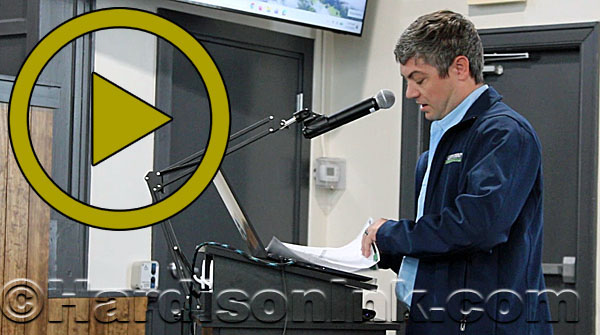
Landon Harrar, the new Levy County economic development manager, gives a lively performance during the quarterly reports part of the May 19 regular meeting of the Levy County Board of County Commissioners. He speaks about 'sit down with people of the community,' as well as 'new projects.' One of the two 'new projects' for Harrar is the development noted in a few previously published stories where the City of Chiefland is working to help a developer bring a Publix to that city, in a two-phase project that will include other retail outlets. To see and hear the video, click on the PHOTO.
Video By Jeff M. Hardison - All Rights Reserved
Beyond the one-minute, one-man entertaining show regarding relatively vague reporting of quarterly economic growth in Levy County, there were significant facts presented by other department heads to show the county is growing in residential population, and meeting demands that the county government is required to fulfill for the residents and visitors of Levy County.
County Manager Harper gave a thorough report of significant projects she completed including the renovation of the auditorium where the County Commission meets, and of the other substantial points of conversion from a former high school campus into an active county government campus.
Levy County Provisional Building Official Bernard ‘Bo’ Cox provided the County Commission with quarterly information regarding development. The formerly separate building department and planning department have been merged into the development department, Cox said as he opened his presentation.
In his quarterly report, Cox said there were 209 zoning compliance applications for houses, as well as seven plat proposals. There were 564 building permit applications during the three-month second quarter fiscal year period of January, February and March. Of those, 188 building applications were for new residences, Cox said.
“That just shows that development in the county is steady and continuing to increase,” Cox said.
In regard to staff members in the department, this is the first time since combining building with planning that the development department is fully staffed. One of the new staff members has been working in the department through a cooperative agreement with the Levy County School District and Williston Middle High School. She has exceeded expectations, Cox said, and he foresees after her upcoming graduation that she will be a long-term employee.
And while there are new structures being built for people to live in Levy County, the code enforcement department has shown its activity increasing during the past three years as it accepts complaints about current violations. The most recent report shows the county government is answering calls from complaints of zoning and building ordinance violations in a much higher and effective manner than in the past several decades.
Levy County Code Enforcement Manager Dave Banton reported that in the second quarter of Fiscal Year 2025-2026, there were 64 cases. There were 40 cases that were closed by people coming to compliance with the codes or through other end results. There were 25 cases, Banton said, during this quarter which required rulings by Levy County Special Magistrate Norm D. Fugate.
Some of those cases were in the category of follow-up compliance hearings, he explained, which means those cases are not new but required another visit before the special magistrate for him to determine findings and deliver judgments that can include daily fines, even leading to liens and eventually having the county government own the property.
Among the most common violations being enforced now in Levy County relate to property owners allowing junk and trash to accumulate to such a high level another person complains to the Levy County Code Enforcement Department. State law prohibits anonymous complaints. Another set of violations relates to people in Levy County using recreational vehicles as residential structures. Speaking of vehicles, the storage on property not designated for the use of storing inoperable, unregistered vehicles is another relatively coming zoning violation that people may comply with when notified, or they may end up with a notice to appear at a code enforcement hearing.
A one-time attempt to clean up the “snipe signs” in Levy County showed some results, but intensive complaints from real estate property salespersons caused that action to fail; resulting in those “yard signs” and other signage that is in violation of the current codes to reappear countywide. With the political season at hand, small wooden billboards with pictures of people running for election are popping up, as are the usual set of yard signs that are being put in county rights-of-way, etc.
Banton said that a third code enforcement officer has been hired and that she is in training now. Currently Banton serves as a code enforcement officer as well as manager of the department. Code Enforcement Officer Bradley Frazier is the second member of the department who is active in investigating complaints and when necessary, bringing those cases toward resolution and compliance via Special Magistrate Fugate.
Banton shared with the County Commission that Levy County Code Enforcement Administrative Assistant Penny Hilligoss was recognized by a property management company that noted via an email to County Manager Harper that Hilligoss demonstrated a high level of professionalism.
There were another 20 or so departmental reports including from Matt Weldon, leader of the Levy County Public Works Division, which incorporated four departments into one division. Weldon now leads the parks and recreation; mosquito control; maintenance; and the water departments. His extraordinary work in parks and recreation and mosquito control for the county has been demonstrated for decades now.
Every department leader provided a wealth of information during the quarterly reports part of the May 19 meeting.
Gilchrist County
amends noise ordinance
By Jeff M. Hardison © May 19, 2026 at 3:30 p.m.
All Copyrights Protected By Federal Civil Law
Do Not Copy and Paste to Social Media or Elsewhere
GILCHRIST COUNTY – As soon as the Floria Department of State puts its seal on the amended noise ordinance for Gilchrist County, it will go into effect, according to what was said at the May 18 meeting of the Gilchrist County Commission.
The revisions show that rather than a time – like after 10 p.m. -- now the ordinance is applicable 24 hours, every single day. It also gives deputies with the Gilchrist County Sheriff’s Office clear instructions on how they can determine if the law is being violated.
The following acts, and the causing thereof, are declared to be a violation of this ordinance.
● The use, operation or playing of any radio, television, phonograph, stereo set, tape player, sound amplifier, musical instrument or similar device:
> Which produces or reproduces sound in a manner as to be plainly audible at a distance of 100 or more feet away from and beyond the real property line of the source of the sound, and which sound crosses the property line of a residential property.
> Which produces or reproduces sound on any public right-of-way in such a manner as to be plainly audible to any person at a distance of 100 feet from the source of the sound.
● The use, operation or playing of any loudspeaker system, sound amplifier or other similar device which produces or reproduces sound which is cast or emitted upon public rights-of-way for the purpose of commercial advertising or for attracting the attention of the public to any building, structure, vehicle or activity.
● The use or operation, of a recreational vehicle (including, but not limited to, dirt bikes, motocross, all terrain vehicles, dune buggies, and similar off-road vehicles) in such a manner so as to produce a sound that is plainly audible at a distance of 100 feet or more away from beyond the real property line of the source of the sound, and which sound crosses the property line of a residential property.
Resources converge on Fanning Springs
for hurricane prep expo
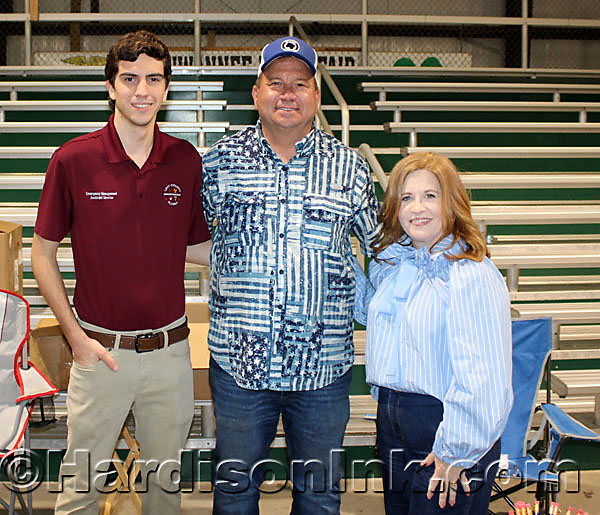
(from left) Levy County Emergency Management Assistant Director Caleb Hardee, Levy County Commission Vice Chairman Charlie Kennedy and Levy County Emergency Management Director Leatha Keene are seen near the table for Levy County Emergency Management. Vice Chairman Kennedy was passing by at the time, and he agreed to be pulled in for the photo op.
Story and Photos By Jeff M. Hardison © May 17, 2026 at 4 p.m.
All Copyrights Protected By Federal Civil Law
Do Not Copy and Paste to Social Media or Elsewhere
CITY OF FANNIG SPRINGS – More than 50 vendors and exhibitors from government and private sources provided hundreds of people with free treats, information, giveaways, door prizes, food and drinks to visitors at the Third Annual Hurricane Preparedness and Community Resource Expo organized and hosted by the Tri-County Community Resource Center, which is part of the Partnership For Strong Families.
The big shindig this year was on Saturday (May 16) starting at 10 a.m. at the Suwannee River Fair Pavilion in the City of Fanning Springs.
Perhaps, some of the visitors thought the 8 a.m. arrival time for vendors was the arrival time for them, or maybe people knew the first 300 people to check in would receive free ready-to-go free freshy prepared barbecue meals – a pulled pork sandwich, coleslaw and baked beans from Heavy B’s Barbecue, and other free treats from Moo’s Lemonade and Jeremiah’s Italian Ice.
And this year, those first 300 entrants accepted a free iron skillet from the United Way of North Central Florida.
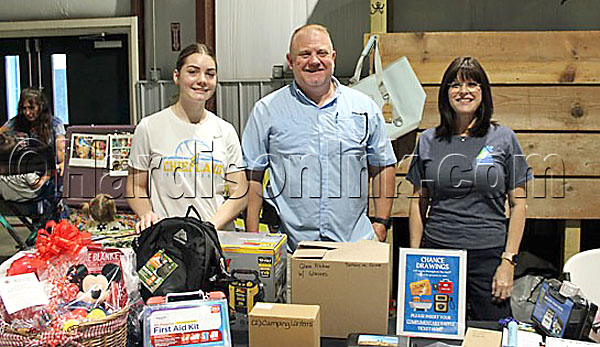
Sadie Haldeman, a student at Chiefland Middle High School (CMHS) and a volunteer at the event (left), Head CMHS Volleyball Coach Aaron Haldeman and Tri-County Community Resource Center Manager Beverly Goodman are seen at the table where door prizes were on display.
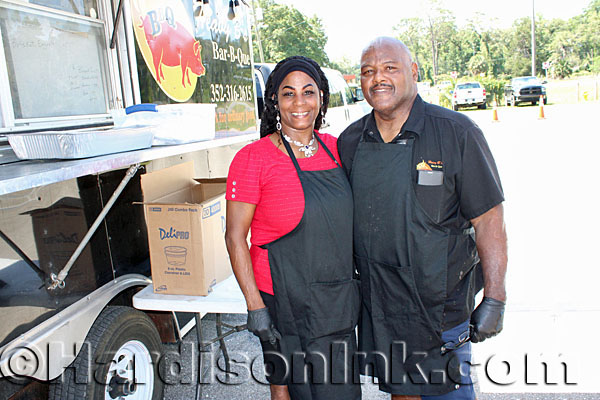
Among the stars of the day are Amelia Greenlee and Bruce Greenlee, leaders of the team for Heavy B’s Barbecue. Chef Bruce Greenlee of Heavy B’s Barbeque was crowned as the ‘Best of the Best Chef’ at the 2026 Taste of the Nature Coast earlier this year at the very same pavilion. And, not only does he and his team serve award-winning barbecue, but he serves the residents and visitors of the Town of Bronson as the mayor.
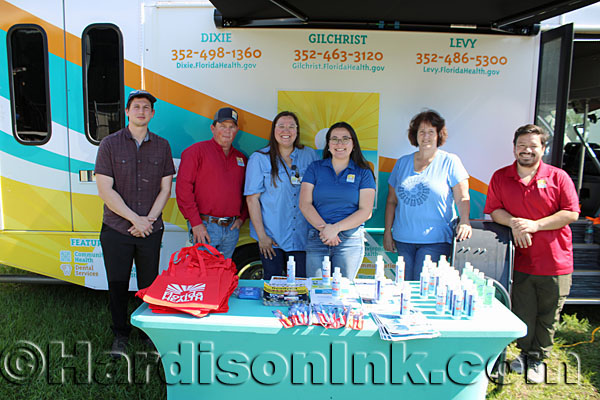
Representing the Florida Department of Health Tri-County Unit at the event are (from left) Thomas Zopf, Earl Jones, Alexis Trosclair, Jan O’Steen, Trinity Williams and Alex Santana.
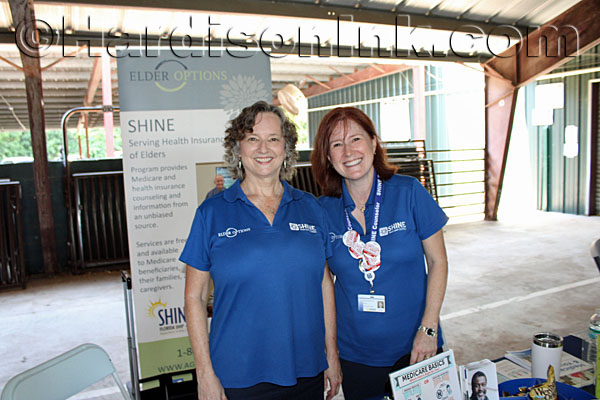
Representing Elder Options and SHINE are Christina Young and Mina Bustamante.

Representing Fanning Springs Fire Rescue are Firefighter-EMT C. Carlson and Firefighter K. Taylor.
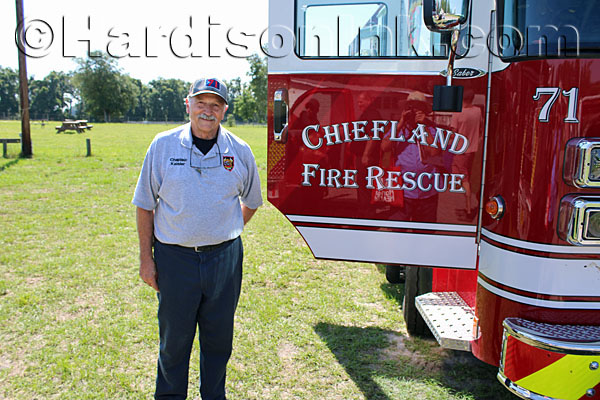
Representing Chiefland Fire Rescue is Chaplain Tom Keisler.
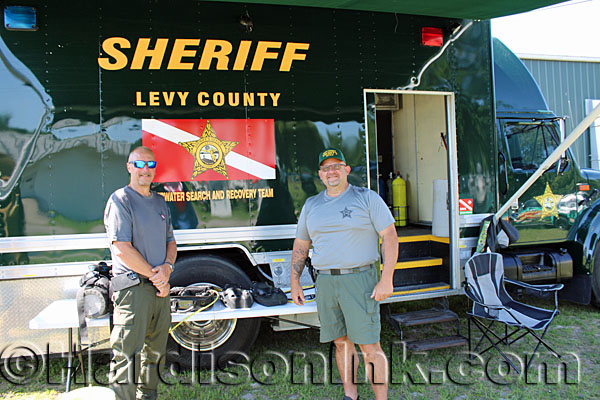
Representing Levy County Sheriff’s Office Underwater Search and Recovery Team are LCSO Fleet Manager Lee Dunn (left) and LCSO Reserve Deputy Ray Tremblay, who is one of the three captains of the boat.
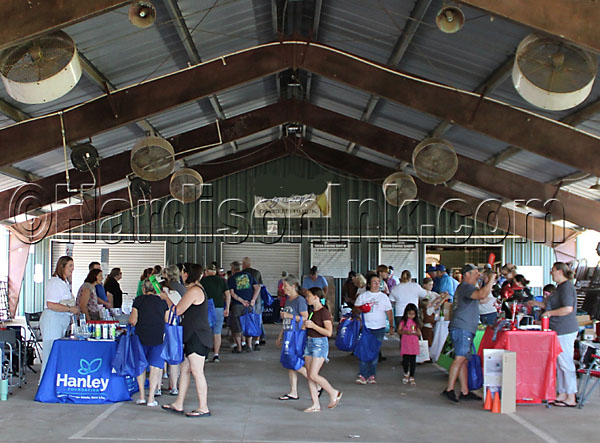
Several of the exhibitors were in the large covered barnlike area of the pavilion, where the big fans were very loud – making verbal communication a little more difficult than in the pavilion or out back on the grassy area.
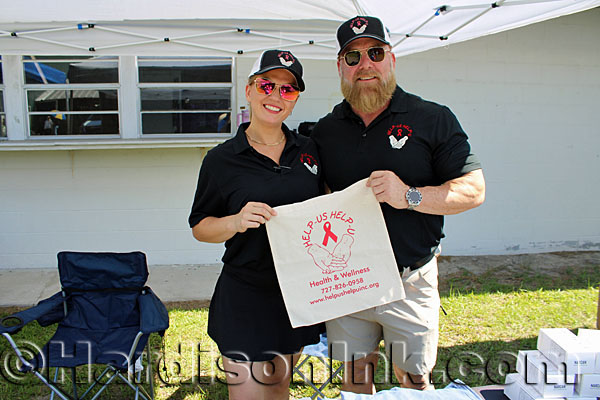
Marissa Dunmire and Dan Dunmire of Help Us Help U Health & Wellness of Chiefland hold a tote bag from their organization. Several exhibitors offered tote bags for free at the event.
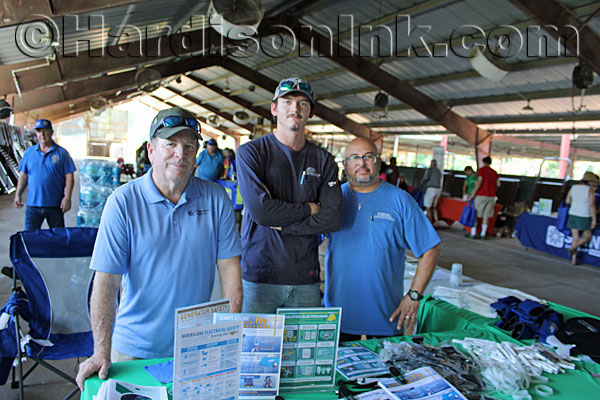
Representing Central Florida Electric Cooperative and Fiber By Central Florida are (from left) Billy Wilson of CFEC Member Services, and Curtis Williams and José Morales of Fiber By Central Florida.

This gift basket filled with items was donated by the American Red Cross as a door prize. There were other gift baskets and items that people accepted for free when their ticket numbers were called. Many of the door prizes were from the Tri-County Community Resource Center.
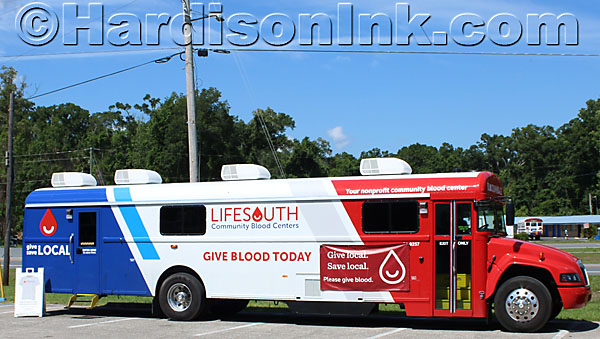
LifeSouth Community Blood Centers had one of its bloodmobile buses available for people to donate blood to save lives locally.

The Alzheimer Association sent its Brain Bus with resources to help people know more about this disease and methods to help patients and their families where it affects them.
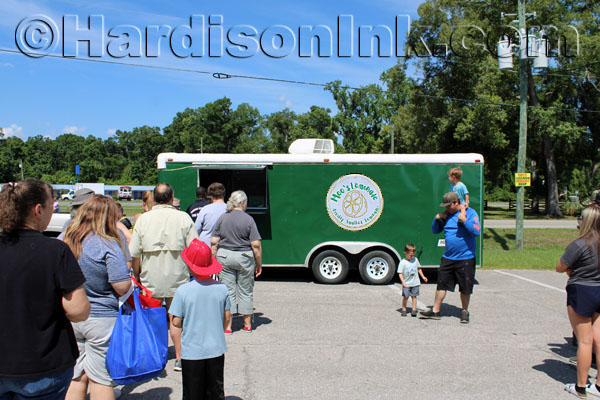
People line up for Moo’s Lemonade of Chiefland. There were 300 tickets given away for this great drink as well as 300 tickets for barbecue meals from Heavy B’s Barbecue.
Beyond those first 300 individuals, who had started lining up at 8 a.m., and who passed through the pavilion doors soon after the 10 a.m. start, there were hundreds more who were given tickets for the many door prizes of the day.
And for all of the folks sauntering through the pavilion, and then trekking onward through the covered barnlike area, and meandering out into the warm sunshine of the day – in back of the pavilion, there were free items galore too.
Toothbrushes, hand sanitizers, first-aid kits, as well as pens, pencils and many other items were easily dropped into the various tote bags that were also free from the exhibitors. Duke Energy was even giving away yo-yos. Another vendor was giving away a generic model Frisbees (plastic, hand-thrown airborne discs).
Information was boundless. People could find all sorts of resources for how to plan for hurricanes and other disasters – as well as to know the laws about outside burning.
Once again, Tri-County Community Resource Manager Goodman and her team of volunteers put together a very beneficial event.
Like last year and the year before, the theme was to help people plan and be prepared for hurricanes and other natural disasters. And that mission was accomplished.
Among the interests joining the Tri-County Community Resource Center at this year’s event were the American Red Cross, the Alzheimer's Association, Another Way Another Way - Domestic Violence & Rape Crisis Center, CDS Family and Behavioral Health Services, the Center for Independent Living, the College of Central Florida, Florida Division Of Blind Services, the Dixie County Sheriff's Office, Dixie County Fire Rescue, Dixie County Community Paramedicine, Fanning Springs Fire Rescue, Chiefland Fire Rescue, Episcopal Children’s Services, Florida Department of Children and Families, Florida Division of Corrections, Florida Department of Health's Dixie-Gilchrist-Levy Unit, Gilchrist County Commission’s Paramedicine Program, Gilchrist County Sheriff's Office, Haven Hospice, Levy County Emergency Management, Cedar Key Lion’s Club, Elder Options-SHINE; Hanley Foundation, Levy County Sheriff's Office, Meridian Healthcare, Three Rivers Legal Services, the Palms Medical Group, the LifeSouth Community Blood Services Bloodmobile, and Endeavors.
And there were several others there as well.
To see the April 17, 2025 story, photos and (see and hear) the video under the headline title of Disaster Prep Expo Draws People To Fanning Springs, click HERE.
Dixie County Chamber of Commerce
solves parking problem
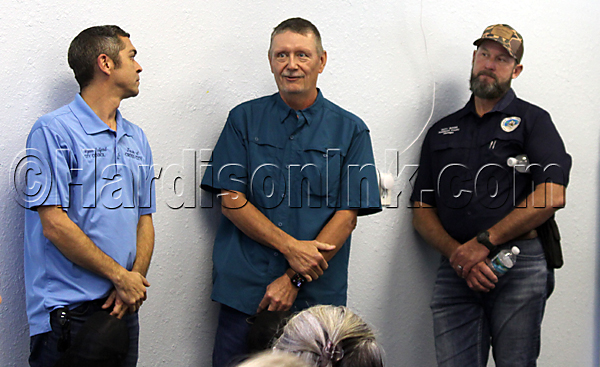
(from left) Cross City Mayor J. Ryan Fulford, Dixie County Commission Chairman Mark Hatch and Dixie County Assistant County Manager Roy Bass are seen at the very end of the Dixie County Chamber of Commerce meeting on Thursday afternoon (May 14) in the Dixie County Public Library Conference Room, where the Chamber’s monthly luncheon meetings used to be held for many years.
Story and Photo By Jeff M. Hardison © May 14, 2026 at 9:30 p.m.
All Copyrights Protected By Federal Civil Law
Do Not Copy and Paste to Social Media or Elsewhere
CROSS CITY – The monthly meeting of the Dixie County Chamber of Commerce went a bit beyond the 1 p.m. planned ending time on Thursday afternoon (May 14), as Dixie County Commission Chairman Mark Hatch and Cross City Mayor J. Ryan Fulford helped members and guests understand the potential for the June monthly meeting to be in Cross City’s City Hall – rather than in the Dixie County Public Library. As Commission Chairman Hatch said, there are apparently not enough parking spaces at various places near to businesses in Cross City. For instance, when the Dixie County Public Library has a large number of people attending an event – such as the monthly Chamber of Commerce meeting or the weekly Rotary Club meeting, or the several events that happen in the summer, then Forever 54 Flowers and Gifts find its customers are unable to locate a parking place.
While the Rotary Club of Dixie County, and the Three Rivers Public Library System are going to need a solution to the ongoing parking war with the shop owner in Cross City, the Dixie County Chamber of Commerce has solved its parking problem.
Mayor Fulford said City Hall can easily accommodate the 43 or so people like the number that showed up for the luncheon meeting on May 14.
At some point in the future, the Dixie County Chamber of Commerce meetings may be switching to be in the Dixie County Woman’s Club Clubhouse, too. That clubhouse is across from the southwest corner of the Dixie County Courthouse.
So, it looks like June’s meeting of the Dixie County Chamber of Commerce may be in City Hall.
As for July, as usual, the Dixie County Chamber of Commerce is not meeting that month.
Well abandoned, new well established

The start of the drilling begins. Notice the large truck is elevated with its front wheels on blocks, too. This is a level platform for drilling down at a 90-degree angle.
Story, Photos and Videos By Jeff and Sharon Hardison
© May 12, 2026 at 3:30 p.m.
All Copyrights Protected By Federal Civil Law
Do Not Copy and Paste to Social Media or Elsewhere
LEVY COUNTY – All’s well that ends well.
“All’s well that ends well” originates from a medieval proverb emphasizing that a positive outcome justifies previous hardships. The phrase, perhaps not quite a proverb, has its earliest roots appearing in 13th-century English literature.
While used as a title for a poem titled All’s Well That Ends Well, written in 1601 by William Shakespeare (1564 - 1616), this world-famous poet was well acquainted with John Heywood’s (1497 – 1580) works, which include one titled Dialogue between Reason & Adversity. However, some researchers of literary works have found the origin of the saying goes back even before Heywood’s time.
In the Tri-County Area of Levy County, Dixie County and Gilchrist County in 2026, some wells are just not working well anymore. Combined with growth of the human population and a drought, some wells are drying up in the Tri-County Area.
There are an estimated 125,000 wells in the Suwannee River Water Management District (SRWMD) as of 2026, according to records. The SRWMD includes all of Gilchrist and Dixie counties and most of Levy County, according to records. More than 90 percent of residents living within the 15-county area that is the SRWMD get their tap water from a groundwater source, according to records. The SRWMD typically has seen more than 3,000 new well permits issued each year, with an average of over 110 permits for domestic self-supply wells issued monthly, according to records. The Upper Floridan Aquifer is the primary source for these wells, according to records.
If the outcome of a situation or undertaking is a happy one, that makes up for any earlier unpleasantness or difficulty. All’s well, that ends well.
This phrase is a bit happier than “It is what it is,” which may be today’s version of “Qué Será, Será (Whatever Will Be, Will Be).” Qué Será, Será is from a song written by Jay Livingston and Ray Evans and first published in 1955. The song was included in an Alfred Hitcock movie by the title of The Man Who Knew Too Much. The Man Who Knew Too Much is a 1956 American mystery thriller film directed and produced by Alfred Hitchcock, starring James “Jimmy” Stewart and Doris Day. It is a remake of Hitchcock’s own 1934 film of the same name, with a similar but significantly altered plot.
When told by François Truffaut (1932–1984) that his 1956 remake of The Man Who Knew Too Much was superior to the 1934 original, Hitchcock replied, “Let’s say the first version is the work of a talented amateur and the second was made by a professional.”
The quote comes from the 1967 book-length interview Hitchcock/Truffaut, where they discussed his films. This was the only time Hitchcock remade one of his own films, using it to fulfill a contractual obligation to Paramount, according to records.

In this three-minute set of video clips spliced together, which is somewhat noisy, part of the various moments of the drill going down and water samples coming out are seen on Monday (May 11). Click on the PHOTO to see and hear the video.
Video By Jeff M. Hardison – All Rights Reserved
As for the happy ending of the well abandonment and new well creation completed on May 11, when a new well was made and a new pump was added, that great and wonderful ending was after a sad discovery started on May 1, when a well went dry.
The proverbial bottom line is that a two-inch well that was created probably in the 1960s “gave up its ghost,” so to speak. As for the history of the well at that one Levy County residence, it was about 13 years ago, thanks to Ken Sheffield of Sheffield Pumps, that old well had served as the water source for The Ink Pad since Sept. 1, 2013.
Sheffield installed a pump to replace the one stolen from the property before Jeff and Sharon Hardison bought it. People have stolen things and still steal things in rural Levy County.
.JPG)
At this point in the project, water is cycled through the drill site and returned with soil, sand, lime rock, small pebbles and the like.

The water turns to a shade of white as the drill goes down into an area of lime rock.

Here the safety blankets over wires are seen after they were placed before the drilling process began. This stopped a potential arc of electricity due to the relatively close proximity of the drilling equipment to the electric power transmission equipment, including a transformer.

In this picture, Jessica Wright is seen putting a shovelful of powdery lime rock out of the bucket where it was delivered from underground as part of the drilling operation. This whole process demanded a lot of physical labor from the three-member crew.

A trailer used to transport hundreds of gallons of water used in the drilling operation is seen here. Pipes, a tank and other material and equipment were on this long trailer, too.

John Wright watches the drilling machine work as he moves a lever.

John Wright shows a clear stream of water coming from underground here -- after hours of work.

Clear, high quality water shoots from a hose as John Wright holds up a bottle with it – ready for the taste test.

With the drill having established the point for the submersible pump to bring up the water, Austin and John Wright begin setting up pipes and electronic controls.

Jessica and John Wright dig a path for an electric conduit to be placed.

(from left) Austin, Jessica and John Wright stand next to the tank after completing a drill and pump mission that went perfectly. Each site and each job is unique.
After a few days of conference at the end of the very localized 10-day disaster period, the project started -- with results that were so positive they exceeded even the highest expectations.
Wrights Well Drilling & Pump Service brought water service back to the residence.
John and Jessica Wright, assisted by Austin Wright, completed the well drilling and pump installation in one day. They worked several hours; first, taking all of the actions to abandon the previous well; then drilling for several feet through lime rock and other geological features; laying pipe for water and conduits for 220-volt electric current; as well as sifting shovelfuls of soil and rock particles as the drill went deeper in search of the best place for continuous water service; and more.
Working closely to electric power transmission lines, the tall machinery was protected from the danger of electric arcing thanks to Central Florida Electric Cooperative placing protective gear over the danger zone before the work began, and then removing the safety equipment within hours of the heavy machinery being driven away.
The water that came from the new deep well was free of iron and calcium. It was clear and clean.
Before that, from May 1 through May 10, the Hardison couple were using buckets of water from a neighbor’s hose to flush the toilets. There were no showers. Laundry was completed at a laundromat. At 3 p.m. on Friday, they checked into the Days Inn of Chiefland.
“It was not the Ritz Carlton,” Jeff Hardison said. “It was not the Hilton. We didn’t sleep there, as we have done that for weeks on end from hurricane evacuations over the 20 years we’ve been here so far. There was a shower, and we grabbed some gallon jugs of water to bring home for flushing toilets.”
Hardison said he is glad Sheffield referred him to Wrights Well Drilling & Pump Service after a valiant attempt to fix the issue by adding more pipe deeper in the original well failed. The underground water level was just too low for the original pump to pull up water via that original well.
When the job was complete, there was a four-inch galvanized well with 59 feet of casing, with a 75-foot total depth at a 26-foot water table. The pump was hung 54 feet deep. That one-horsepower submersible pump provides 20 gallons per minute into an 81-gallon bladder water tank. There was a 12-foot one and a quarter inch drop pipe and submersible wire that was not anticipated before the project started. Also, as part of the total project, the two-inch well was abandoned per the specifications required by the Florida Department of Health and Florida Department of Environmental Protection; and of course, the new well hookup and well line.
All is well that ends well; however, getting to the end point where the "all" is what is desired -- well, that is a story.


PLEASE CLICK ON ADS TO GO TO WEBSITES. THANK YOU!

Click On Ad To Go To Website

Click On Ad To Go To Website


Click On Ad To Visit Website.


Click On Ad To Visit Website.
Click On Ad To Go To Website.

Click On Ad To Visit Website.

Click On Ad To Visit Website.

Click On Ad To Visit Website.


Click On Ad To Go To Website.

Click On Ad To Go To Webpage.

Click On Ad To Visit Website.


Click Ad To See Webpage.

Click On Ad To Go To Website.

Click On Ad To Visit Website.

Click On Ad To Visit Website.

Click On Ad To Go To Website.

Click On Ad To Visit Website.

Click On Ad To Visit Website.

Click On Ad To Visit Website.

Click On At To Visit Websits.

Click on Ad To Visit Website.


Please Click Above
To See Ad Rates And Reach.

Please Click On The Above Ad To Go To The Archived Stories And Photos.